
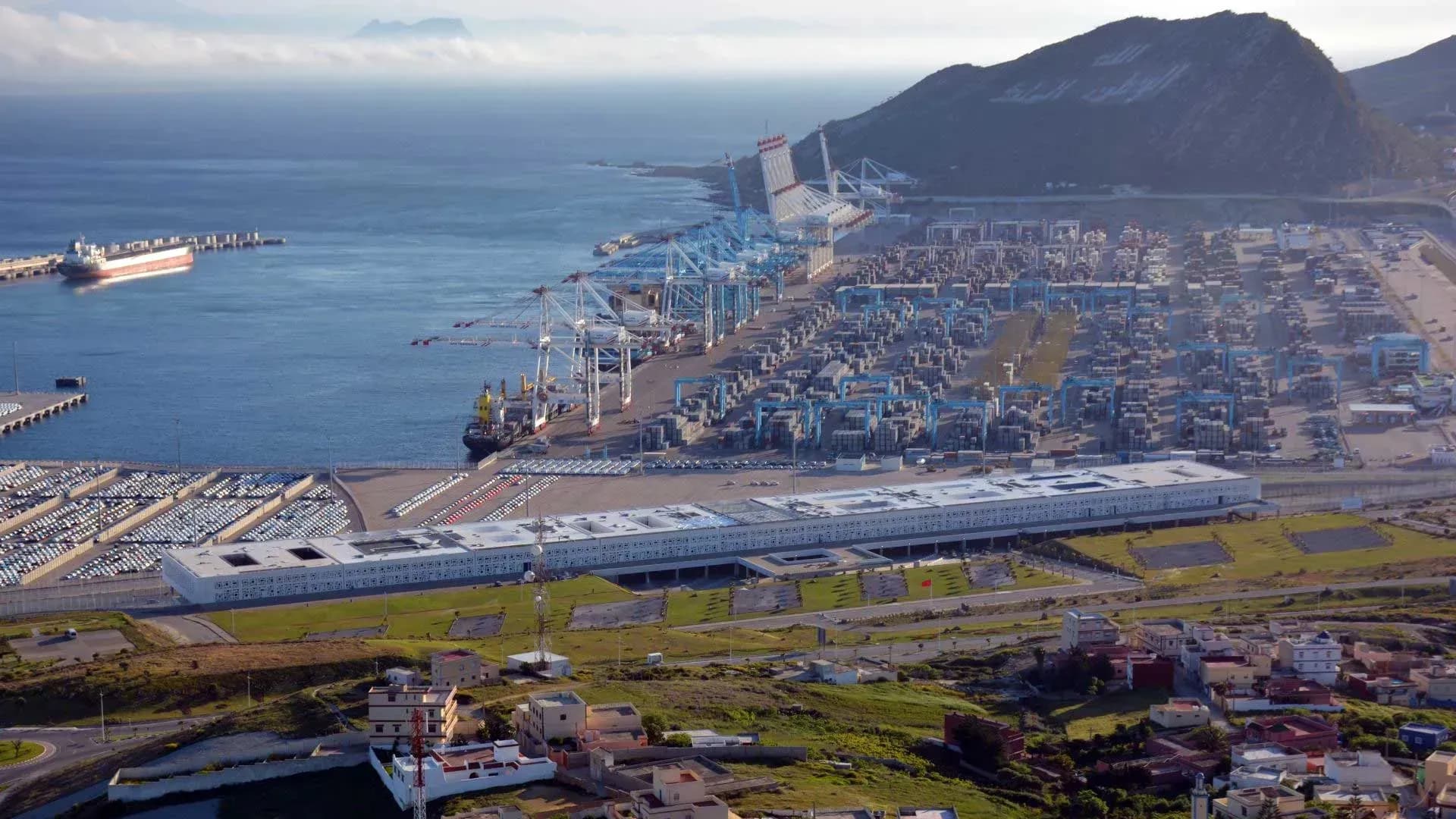
On the hills extending outside Tangier, on an area of 500 hectares taken from agricultural land, the latest manifestation of Chinese manufacturing power in the automotive sector is rapidly growing. Mohammed VI Tanger Tech City houses an emerging conglomerate of Chinese automotive component manufacturers, from brakes to battery materials, aiming to fuel the European continent's electric transition. Sheep still graze up to the walls of the enclosure, but in Brussels, concern grows: the billions of dollars that Chinese companies plan to invest in Morocco could turn the North African country into a launch platform for heavily subsidized products destined for the European market, according to recent coverage from theFinancial Times.
The European Trade Commissioner, Maroš Šefčovič, has pointed to Morocco as a symptom of Chinese efforts to manage its industrial overcapacity by 'diverting' exports through trade partners to Europe. Against a backdrop of increasing trade tensions, the European Commission has intensified its defense mechanisms against China and its alleged satellite countries. Last year, it ruled that aluminum wheels exported from Morocco were being 'unfairly subsidized' by Rabat and Beijing through the Belt and Road infrastructure investment program. In March 2025, Brussels imposed a countervailing duty of 31.4% on aluminum wheels produced by Dika Morocco, a subsidiary of the Chinese firm Citic Dicastal, a decision made without prior consultation with Moroccan authorities.
Community sources cited by theFinancial Times acknowledge that it is difficult to distinguish genuine industrial collaboration with Morocco from attempts to evade European import tariffs. The EU has imposed tariffs of up to 45% on Chinese electric vehicles. The OECD estimates that China subsidizes its industry at a rate between three and eight times higher than that of member countries, often through hard-to-detect and combat soft loans.
A supply chain around Tangier and Kenitra
Chinese companies present at a recent investor conference held in Casablanca, organized by the Dentons law firm, argue that Morocco is an essential node in European automotive supply chains. Both Renault and Stellantis, owner of Peugeot, maintain large plants in the country, complicating any measure of trade defense. Junjie Cai, project director of the Chinese brake manufacturer APG, which will open a $70 million facility in the Tanger Tech area this year, explained that the plant will combine local labor and materials with supplies and technology from China. 'European, Moroccan, and Chinese companies can all share the benefits of this collaboration. This also allows for supplies to be offered at competitive prices close to their factories in Europe,' he stated. The European Automobile Manufacturers Association, the main lobby in the sector in the EU, declined to comment on the challenges Morocco might pose.
The APG factory will join nearly a dozen Chinese companies based in the Tanger Tech industrial zone. Sentury Tire already operates a tire factory, while BTR New Material Group, the world's largest supplier of battery anodes, is building a plant. Chinese investments in other areas of Morocco include a $1.3 billion gigafactory from battery manufacturer Gotion High-tech, which is 25% owned by the German Volkswagen, being built in Kenitra, 200 kilometers south of Tangier along the Atlantic coast.
Mehdi Laraki, president of the Morocco-China Business Council, states that delegations of potential Chinese investors are arriving in the country at a rate of two or three per week since the end of the pandemic. The Moroccan offer to foreign investors includes a five-year exemption from corporate taxes, a young workforce, green energy sources to reduce the burden of the EU's carbon border adjustment mechanism, and access to 2.5 billion consumers through about fifty national free trade agreements, including with the EU and the United States. These duty-free agreements are one of the main attractions for Chinese companies, according to the consulting firm Fitch Solutions, which noted in a report this year that 'nearshoring production' is seen as a way to mitigate tariff risk. Moroccan Trade Minister Ryad Mezzour stated last December that the country hopes to have a 'complete value chain' capable of serving up to 500,000 electric vehicles per year by the end of 2026.
Moroccan authorities reject suggestions that their special economic zones become a backdoor for China to place its excess production in the EU and deepen the deindustrialization crisis in manufacturing powerhouses like Germany. 'We know that the EU is debating industrial policy, but we believe that Morocco can be one of the best partners in this area. It will be a win-win situation,' says Yassine Elahyani, head of emerging industries at the Moroccan Agency for Investment and Export Development. Elahyani reminded the Chinese investors present in Casablanca of the obligation to respect the so-called 'rules of origin,' which require that goods be sufficiently processed in Morocco to access the community market duty-free. Nevertheless, analysts warn that the magnitude of the planned Chinese investment in Morocco, with about $6 billion announced since the pandemic according to data from consulting firm Rhodium Group, will pose a challenge for European policymakers.
A key test will be whether the EU classifies Morocco as 'European' for the purposes of the Industrial Accelerator Act recently proposed by the Commission, a regulation designed to protect the community's industrial base, which is rapidly eroding. If approved, it would restrict part of public procurement to vehicles and other products manufactured with European content. The European Association of Automotive Suppliers (Clepa) acknowledges that it is already pushing for action against subsidies and tariff evasion by trading partners. In its view, non-EU countries should only be included under the IAA framework if they do not resort to distorting subsidies and apply the same regulatory standards.
As the debate continues in Brussels, construction in Tanger Tech does not stop. Unlike what happens in other parts of Africa, the Chinese footprint around the area is discreet due to strict Moroccan requirements on the use of local labor. The only visible sign of China's arrival in the vicinity is a handful of restaurants in the nearby village, whose modest concrete houses and dusty streets contrast with the shiny white factory buildings in the industrial zone. At the Roi des Nouilles — the 'King of Noodles' — Chinese workers slurp steaming bowls between shifts. Young waiter Soussi Abd Chafi joined other locals in welcoming the investment. 'The Chinese boss is good, I'm still learning to cook Chinese food, and the park brings jobs to Morocco,' he said.
At the Casablanca conference, Leo Luo, project director for North Africa at the industrial developer Holley Global, argued that Chinese investors are focusing on what they can offer European consumers. 'Some people have certain advantages, others have others. We should work together. It's a global market,' said Luo. 'China makes good products now at a fair price, I don't understand why anyone complains.'
The Strait of Gibraltar, the scene of a new industrial geography
The Chinese industrial deployment in Morocco is part of a broader Beijing strategy to consolidate global supply chains and reduce its exposure to geopolitical risks, according to a recent analysis from the Stimson Centre. Morocco has become a prominent partner for China under the Belt and Road Initiative, with Chinese investments in industrial parks, battery production, and mineral processing. This line aims to secure the supply of critical minerals for the green transition, such as phosphate, cobalt, and lithium, essential for electric vehicles and renewable energy systems.
The European Union, for its part, has developed a more rules-based and sustainability-focused approach in its relations with Morocco. The EU-Morocco Green Partnership, launched in 2022, prioritizes climate action, environmental protection, and sustainable development, and the Commission has committed significant financial resources to support Morocco's transition to clean energy. In contrast to this model, Chinese investments are often characterized by their speed, scale, and flexibility, attributes that are attractive to Moroccan authorities seeking accelerated industrialization.
Morocco has chosen to maintain open trade relations with China, thus differentiating itself from the more protectionist stances of the United States, the EU, and India. This strategy has brought more investment and access to affordable goods, but it has also raised concerns about the competitiveness of local industry and trade imbalances. The country's National Mining Strategy 2021-2030 aims to go beyond raw material exportation and promote processing and industrialization. In 2025, Morocco exported over 26 billion euros to the EU, its main trading partner.
The issue takes on a particular dimension on the northern shore of the Strait. Tangier Med, inaugurated in 2007, has become the largest port in the Mediterranean and Africa, and has begun to surpass European references like Algeciras in traffic. What was originally conceived as a regional logistics infrastructure has transformed into one of the main commercial gateways to Europe, and now also serves as the logistical support for an emerging industrial fabric. According to information published by theFinancial Times, China is poised to build an integrated supply chain in Morocco, from processing phosphate for batteries to factories and transport links with ports, which increases the strategic importance of the country for both Beijing and Brussels.
For Morocco, investments translate into employment, infrastructure, and growth. For China, they represent a platform situated right across from European shores, equipped with modern ports and connected by trade agreements with the EU and the United States. For the European Union, they raise a fundamental question about the effectiveness of its tariff instruments when Chinese production can set up on the other side of the Mediterranean and operate under the preferential trade rules that Brussels has signed with Rabat.