

Tanger Med has expanded in the second quarter of 2026 its advantage over Valencia in port maritime connectivity and remains ahead of the first Spanish port for the second consecutive quarter, according to data from the UNCTAD's Port Liner Shipping Connectivity Index (PLSCI). The Moroccan complex reaches 575.79 points, compared to 566.32 for Valencia, placing the difference at 9.47 points. Just one quarter ago, when Tanger Med first surpassed the Valencian port in the series, that distance was only 1.32 points. In the European ranking, the top positions remain unchanged since the beginning of the year: Valencia retains fourth place, Bremerhaven fifth, and Algeciras sixth.
In the world ranking by ports, Tanger Med occupies the 26th position, one place ahead of Valencia (27) and nine above Algeciras, which ranks 35th with 519.21 points. The Valencian port registers the largest year-on-year decline among the major European ports, with a drop of 9.4% compared to the 624.95 points of the second quarter of 2025. Tanger Med, for its part, remains practically stable in year-on-year rate and adds 0.9% over the previous quarter. Algeciras shows a different trajectory than Valencia: it gains 1.2% compared to the first quarter and stays flat in the year-on-year count, so the distance that separates it from the Moroccan port is slightly reduced, from 57.76 to 56.58 points.
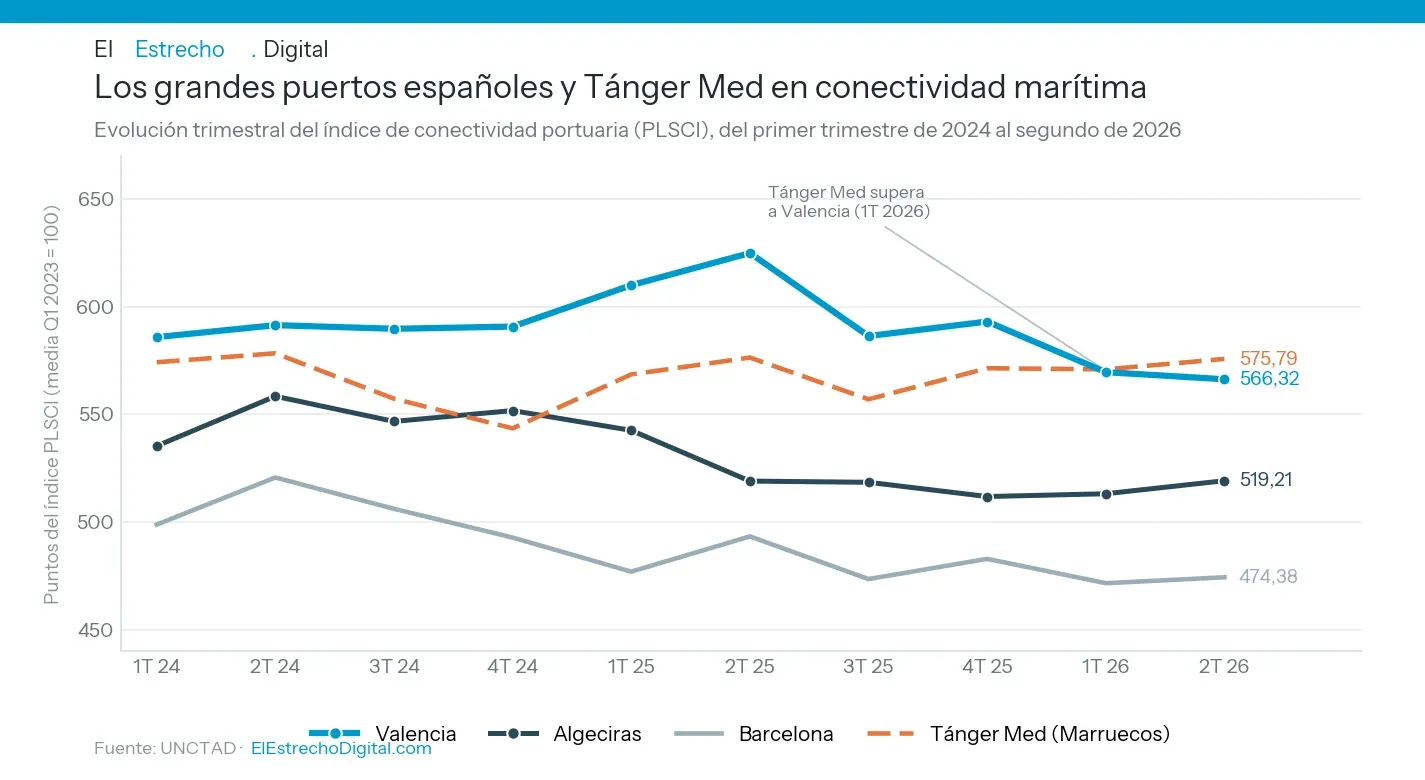
The other reference in the immediate environment of Algeciras, Bremerhaven, retains the fifth position in Europe and widens the gap opened at the beginning of 2026. The German facility reaches 529.84 points, 11.1% more than a year earlier, and once again ranks among the ports that gain the most connectivity within the top fifty in the world. The difference with Algeciras goes from 5.66 points in the first quarter to 10.63 in the second. The German port overtook the Andalusian at the start of the fiscal year and has consolidated that position quarter after quarter.
The European snapshot keeps Rotterdam as the first port on the continent, with 950.83 points, followed by Antwerp (902.03) and Hamburg (690.06). Following them are Valencia (566.32), Bremerhaven (529.84), Algeciras (519.21), and Barcelona (474.38), which grows 0.6% over the previous quarter. Positions eight to ten undergo a rearrangement: Le Havre remains eighth with 436.14 points, Piraeus rises to ninth place with 433.48, and Genoa drops to tenth with 424.07. London Gateway ranks eleventh with 374.08 points. Spain keeps two ports among the six best in the continent and three among the seven best.
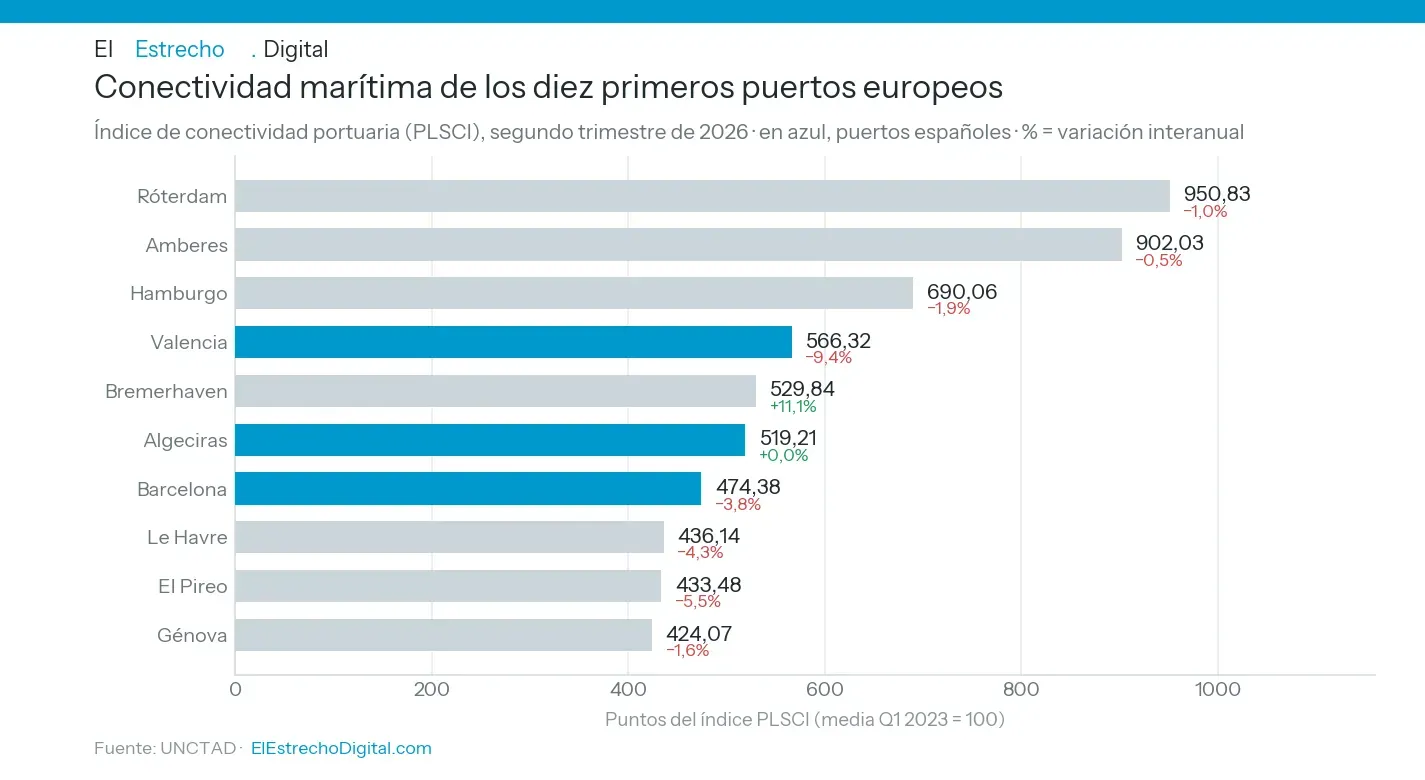
Among the major European ports, year-on-year declines predominate over increases. In addition to Valencia, Piraeus (-5.5%), Le Havre (-4.3%), Hamburg (-1.9%), and Genoa (-1.6%) also experience declines. The largest cuts correspond to London Gateway (-15.2%) and the Portuguese Sines (-15.7%), which falls to 228.34 points. On the increasing side, Felixstowe grows 25.9% to 330.06 points, Fos 12.7%, Gothenburg 12.6%, and La Spezia 10.3% to 305.91. Bilbao and Las Palmas also appear among the European facilities that improve the most in year-on-year rate.
In the world ranking, Shanghai leads the index with 2,372.47 points, ahead of Ningbo (2,040.69), Singapore (1,833.94), Busan (1,655.17), and Qingdao (1,389.05). Completing the top ten are Shekou (1,157.85), Port Klang (1,075.80), Nansha (1,071.13), Hong Kong (976.84), and Rotterdam. Most major Asian ports are losing ground compared to the previous quarter —Shanghai drops by 2%, Shekou by 4.5%, and Qingdao by 3%— in a period of widespread softening at the top of the table. Chinese facilities continue to occupy most of the top positions in the ranking.
Among the Spanish ports located behind the three major ones, Las Palmas maintains its position as the fourth national facility with 264.87 points, 17.5% more than a year earlier, although it decreases compared to the nearly 298 points reached in the first quarter. Bilbao is the fifth Spanish port with 140.83 points and registers the highest year-on-year growth among the main facilities in the country, with 50.2%. Malaga, sixth with 131.22 points, declines by 18% in the past year, while Vigo remains seventh with 124.40. Further back, Gijón (+66.8%), Huelva (+65.2%), Sevilla (+33.7%), and Sagunto (+27.3%) grow strongly; at the opposite end, Marín loses 37.5%, Castellón 6.8%, and Ferrol 5.6%.
In the Liner Shipping Connectivity Index by countries, which aggregates the connectivity of the entire port network of each state, China leads with 1,319.46 points and a growth of 2.2%. It is followed by South Korea (637.15), Singapore (617.63), Malaysia (509.53), the United States (503.89), and Vietnam (489.84), the latter having the largest increase among the first economies (+6.7%). Spain regains the seventh position in the world with 416.61 points, a position that it had ceded to Japan the previous quarter. The difference between the two countries is narrow: the Spanish index exceeds the Japanese (415.71) by 0.90 points, after Japan declined more sharply over the past three months.
By countries, Spain also reaffirms the first position in Europe, ahead of the United Kingdom (387.63), the Netherlands (380.80), Belgium (342.08), and Germany (325.47). The Spanish advantage over the second-place contender expands compared to the previous quarter, increasing from 25.34 to 28.98 points, despite the national index declining by 2.0% year-on-year. Italy ranks sixth with 290 points and France seventh with 269.60. Greece and Portugal occupy the eighth and ninth positions, with 173.04 and 169.49 points respectively. Morocco rises one place in the world ranking by countries, reaching 22nd position with 265.52 points and a year-on-year growth of 2.7%.
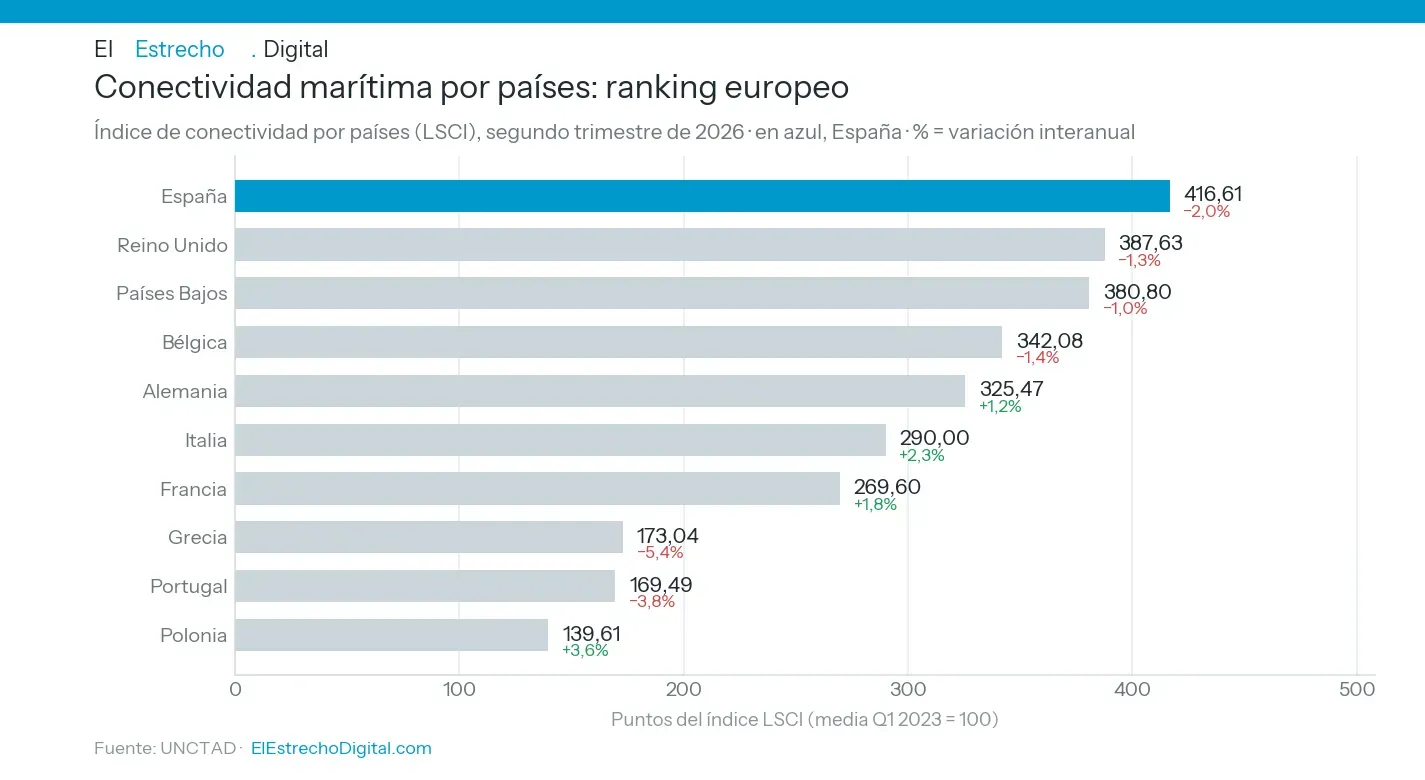
The picture of the second quarter combines stability at the top of the rankings with a divergence that continues below. The major Spanish ports maintain their European positions, but their direct competitors in the Strait and in northern Europe, Tanger Med and Bremerhaven, are steadily gaining ground. Nationally, Spain recovers a place in the world ranking by countries and maintains European leadership, which nuances the strictly local reading of port movements. The connectivity measured by UNCTAD depends on the density of services, calls, and direct links, a factor in which the evolution of transshipment has a decisive weight for hub ports like Algeciras.