
The International Maritime Organization (IMO) has adopted the first global regulatory code specifically designed for autonomous surface ships, known as the MASS Code (Maritime Autonomous Surface Ships), after the conclusion of the 111th session of the Maritime Safety Committee (MSC 111) held in London on May 22. Spain, which has actively participated in the entire drafting process over the past eight years, has positively assessed the approval of a framework that represents an unprecedented legal milestone in the maritime sector, having developed in parallel to the technological evolution of autonomous ships.
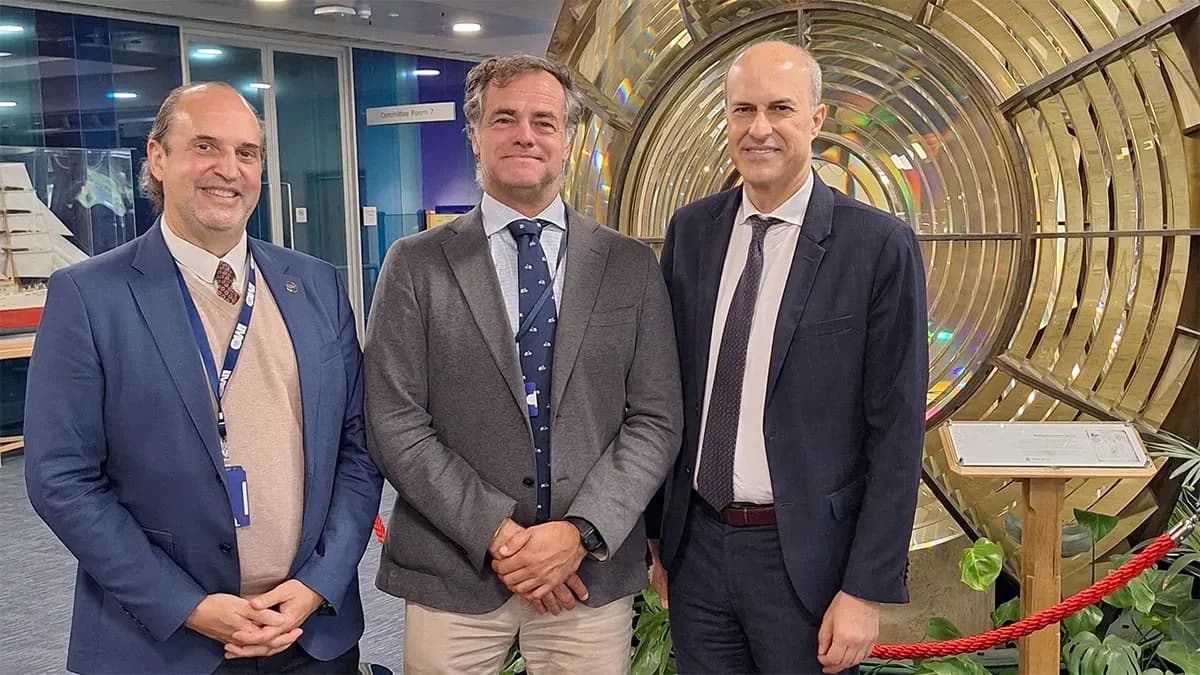
The Spanish delegation at MSC 111 was formed by Víctor Jiménez, president of the IMO Council and permanent representative of Spain to the organization (REPER), his colleague at REPER Andrés Galván, and Hernán del Frade, coordinator of the national working group on autonomous ships and safety and environmental advisor of the General Directorate of Merchant Marine.
The MASS Code will come into effect on July 1, 2026, as a non-mandatory instrument, initiating what the IMO calls the "Experience Building Phase," the formal framework for which will be developed at MSC 112, scheduled for December 2026. After this trial period, during which the suitability of the code for regulating this type of ship will be evaluated, it will proceed to review and adopt a mandatory version, anticipated for July 1, 2030, with effective entry into force through amendments to the SOLAS Convention on January 1, 2032.
In its current form, the code applies exclusively to cargo ships. The IMO has postponed the issue of its extension to passenger ships, a decision that responds to the greater complexity involved in safety and liability considerations in autonomous operations with passengers on board. The organization has indicated that it will examine that expansion as operational experience accumulates during the voluntary phase.
The MASS Code contemplates four levels of autonomy that the IMO has been delineating over several years of preparatory work. In level one, crew members remain on board supported by automated decision-aiding systems. In level two, the ship is operated from a remote location, but the crew is still present on board. Level three entails remote control of the ship with no crew on board. Level four involves complete autonomous operation, where the ship's own systems determine actions without direct human intervention. The code addresses all four levels, meaning the regulatory framework has not been built around a single idealized vision of the future of autonomous navigation but instead considers the spectrum of operations that is already emerging in the commercial sector.
One of the most relevant design decisions of the code is its goal-based structure, rather than a prescriptive regulation. Autonomous navigation technology, which encompasses artificial intelligence, remote sensors, satellite communications, and increasingly sophisticated vessel management software, evolves at a pace that exceeds any conventional regulatory cycle. A prescriptive code drafted today would risk becoming obsolete before its mandatory enforcement. By establishing safety outcomes instead of specific technical solutions, the IMO has produced a framework capable of accommodating yet unforeseen technological developments while maintaining consistent expectations for safety, protection, and the environment.
The principle of equivalence constitutes one of the pillars of the code: autonomous or remotely controlled ships must meet the same safety, protection, and environmental standards as conventional ships. The MASS Code does not create a lower level of regulatory requirements for ships with fewer crew or none, but seeks to ensure that the reduction or elimination of onboard crew does not translate into a decrease in operational safety.
Regarding liability, one of the most debated issues concerning autonomous navigation, the code maintains the figure of a designated captain, whether on board or from a Remote Operations Center on land. That captain must have a real capacity for intervention, a mandatory requirement and not a mere aspiration. The Remote Operations Centers themselves will be subject to certification by the flag state administration of the ship they operate, introducing for the first time at an international level a formal accountability structure in the operational dimension from land.
The code covers a wide range of subjects: system design, software principles, connectivity, navigation, alert management, remote operations, fire protection, cargo handling, safety, search and rescue, machinery and electrical installations, inspections and certification, risk assessment, and anchoring and mooring. Structurally, the text replicates the architecture of conventional maritime safety regulation, so that inspectors, experts, and insurers have a recognizable reference point when addressing an autonomous ship.
The adoption of the code provides a degree of regulatory certainty that the sector has lacked until now. For investors and technology developers, that certainty has direct consequences: capital allocation decisions in maritime transport operate on long cycles, and a ship commissioned in 2026 may remain in commercial service well into the 2050s. Shipyards and design offices now have a framework against which to assess readiness for automation and remote operation capabilities. Classification societies face the more complex challenge of developing assessment methodologies for software integrity, artificial intelligence systems, and remote control functionality. Insurers will need to review risk models built on human operational behavior, and port authorities will have to consider the implications for infrastructure for ships operating under remote supervision.
The next six years will be a decisive period. The voluntary phase is designed to generate real operational data, performance evidence, and regulatory feedback to inform the mandatory instrument. Conventional crewed ships will continue to dominate commercial operations in the foreseeable future, but the autonomous ship already has a legal identity within the international regulatory system and a defined roadmap towards mandatory regulation.