
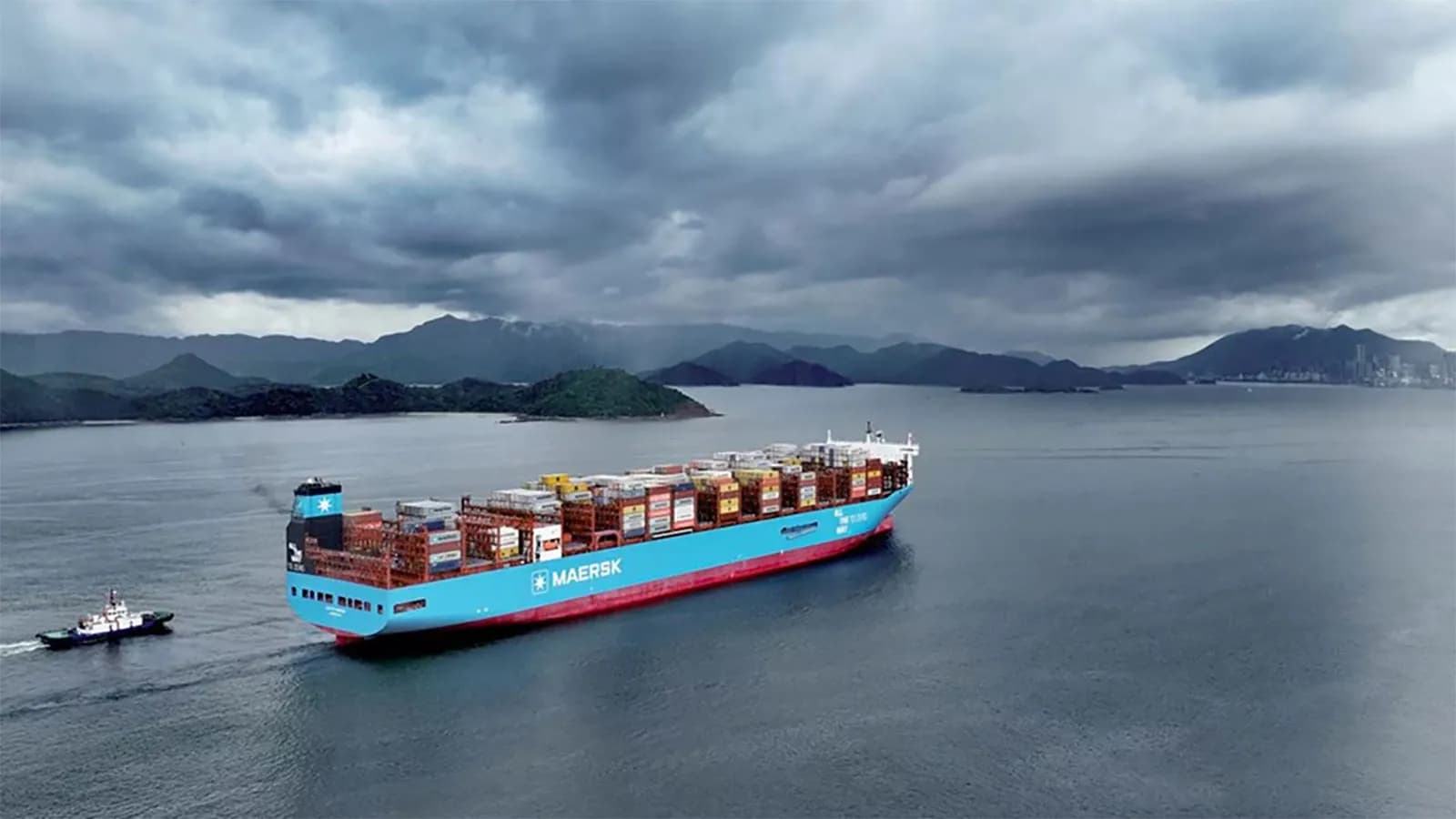
Maersk and Hapag-Lloyd have decided that services AE19 and AE15 will transit through the Suez Canal instead of using the route around the Cape of Good Hope, after assessing the security situation in the Red Sea area. The modification represents a limited return to the Suez corridor and, for now, does not extend to the entire East-West network.
The Danish shipping company has explained in its European market update for September that these changes have been specifically adopted for both services and do not represent a general return of its connections between Asia and Europe to the Red Sea and Suez route.
The company continues to monitor the situation in the area and will communicate any potential modifications related to transits through Suez. Maersk notes that conditions remain unpredictable and that its decisions will prioritize the safety of people, assets, and transported goods.
The situation of connections between Asia and Europe is also influenced by the typhoon season of 2026 in East Asia. According to Maersk, activity has been above normal levels, with several severe typhoons making landfall over a period of two weeks.
Weather phenomena have caused flooding, congestion, and delays in ship operations at various points in the region. Schedule adjustments, congestion, and capacity restrictions arising from this situation are impacting the entire maritime network, including Europe.
These circumstances are compounded by the proximity of China's Golden Week, expected in the first week of October. During this festive period, worker availability traditionally decreases, and factory closures occur, affecting production schedules and logistics operations.
Maersk plans to adjust its network between Asia and Europe during this period to limit disruptions caused by reduced activity in China.
In European ports, the company also points out various operational issues. Recent labor actions at German terminals have added to the existing pressure in Northern Europe and have affected connections through Hamburg, Bremerhaven, and Wilhelmshaven.
Maersk continues to monitor this situation and expects to inform its clients of any potential schedule changes and contingency measures that may be adopted.
In Belgium, terminals have recently recorded longer waiting times due to a lack of available pilots. According to the shipping company's information, activity has returned to normal levels after recovering the usual availability of these professionals.
Congestion continues to affect key ports in Northern Europe and the Mediterranean. The company indicates that high demand and certain operational limitations are also putting pressure on the capacity of various services.
In this context, Maersk recommends making reservations in advance, providing accurate forecasts of goods and the corresponding documentation, and quickly removing import containers to facilitate terminal operations.
Difficulties also extend to European inland transport. Low water levels continue to affect some of the main waterways, especially in the Netherlands and Germany.
Conditions recorded on the Rhine have reduced the available capacity for transport by barges and have created difficulties for inland terminals. The company continues to monitor water levels and their consequences on operations.
Maersk's update also includes various regulatory changes that will affect European trade in the coming months. The European Union Regulation on deforestation-free products (EUDR) is expected to be applicable from December 30, 2026. The European Commission has published new guidelines on various compliance requirements.
New requirements will also be introduced from October 1, 2026, in the customs declarations for importers of steel from the European Union. These include the obligation to provide traceable evidence of where the steel was originally melted and cast.
In relation to the Carbon Border Adjustment Mechanism (CBAM), Maersk notes that affected importers must review the emission calculations corresponding to 2026 that used default values. The European Commission has revised these values retroactively from January 1 of this year, which may affect the number of CBAM certificates needed.
Air cargo, for its part, is experiencing growth in global demand. Data from the International Air Transport Association (IATA) cited by Maersk shows a year-on-year increase of 12% in June, with particularly significant demand for higher-value goods linked to technology, semiconductors, and artificial intelligence.
European import volumes have also increased, while European exports have returned to positive growth rates.
The September update places Maersk's European operations in a scenario influenced by the limited return of certain services to the Suez Canal, the consequences of typhoons in East Asia, terminal congestion, restrictions on river transport, and the entry into force of new European Union regulatory requirements.