
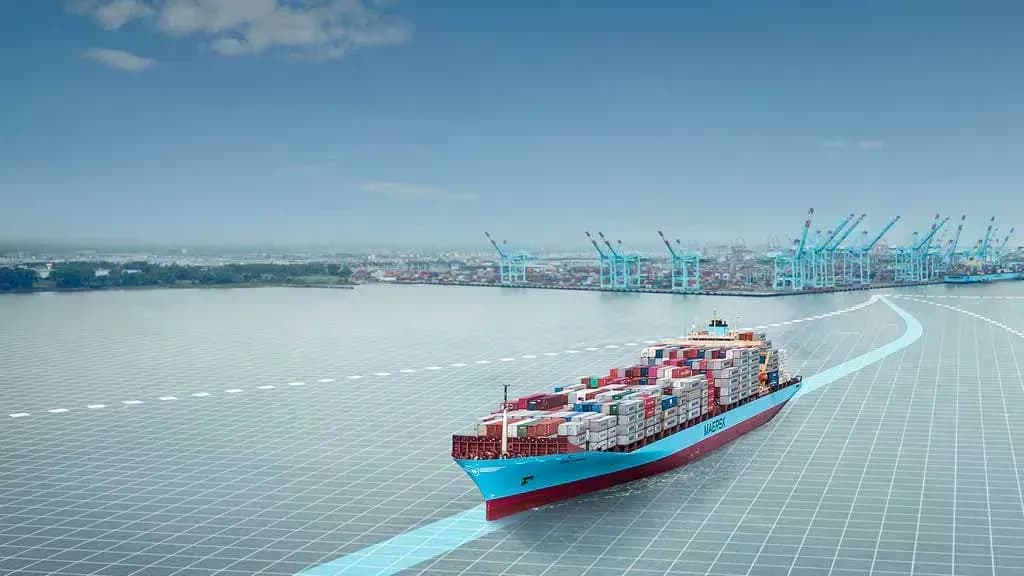
A.P. Moller-Maersk has presented the results for the first quarter of 2026, a period marked by volume growth in all three divisions of the group —Ocean, Logistics & Services, and Terminals— but also by the persistent downward pressure on maritime freight rates, caused by excess capacity in the global container fleet. Consolidated revenue stood at 12.970 billion dollars, 2.6% lower than the 13.321 billion in the first quarter of 2025, while operating profit (EBIT) fell to 340 million dollars, compared to the 1.253 billion a year earlier. EBITDA fell to 1.753 billion dollars from 2.710 billion dollars in the comparable period.
Maersk's CEO, Vincent Clerc, stated that the company has recorded solid demand in most regions, which has supported robust volume growth in the three business segments. Clerc emphasized that the flexible network of the ocean division continues to demonstrate its value, having allowed for a 7% reduction in unit costs even with the disruptions caused by the conflict in the Middle East.
The Ocean division, which accounts for the bulk of Maersk's activity, experienced a 9.3% increase in loaded volumes, reaching 3.2 million FFE (forty-foot equivalent units), primarily driven by Asian exports. However, the average freight rate per container fell by 14%, down to 2,081 dollars per FFE compared to 2,427 dollars in the first quarter of 2025. This decline in rates, caused by industry overcapacity —the global nominal fleet was 6.3% larger than a year earlier— dragged the division's revenues down by 8.2% to 8.178 billion dollars and took EBIT into negative territory, with an operating loss of 192 million dollars compared to a profit of 743 million a year earlier. Operating costs remained stable at 7 billion dollars thanks to a 16% reduction in the average price of bunker fuel and a 5.3% improvement in fuel consumption, while the fleet utilization rate reached 96%, compared to 92% in the comparable period.
The Logistics & Services segment recorded its eighth consecutive quarter of year-on-year improvement in the EBIT margin, which rose to 4.6% from 4.1% a year earlier. Revenues for this division grew by 8.7%, reaching 3.793 billion dollars, with widespread improvements across all service lines: land transport activity (Transported by Maersk) increased by 10%, warehousing and distribution (Fulfilled by Maersk) increased by 8.3%, and supply chain management (Managed by Maersk) increased by 6.1%. Air cargo volumes surged by 20% year-on-year. The EBIT of the division reached 173 million dollars, 22% more than the 142 million in the first quarter of 2025.
The Terminals division completed another solid quarter, with volume growth of 4.3% to 3.47 million movements, led by North America, where activity grew by 11%. Revenues stood at 1.314 billion dollars, up 6.7%, and EBIT rose to 436 million dollars compared to 394 million from the previous year, with a margin of 33.2%. APM Terminals made progress during the quarter on several strategic expansion projects: the Suape terminal (Brazil) entered its final construction phase with an investment of 350 million dollars; Phase II of Lázaro Cárdenas (Mexico) was inaugurated and the construction of Phase III began for another 350 million dollars; the company acquired a 49% stake in the Hai Phong terminal (Vietnam); and a partnership was formalized with DP World at the port of Jeddah (Saudi Arabia). Following the quarter's end, APM Terminals and Eurogate agreed to invest 1 billion euros in the modernization of the North Sea terminal in Bremerhaven (Germany), to increase its capacity from 3 to 4 million TEUs.
In terms of investments, Maersk commissioned eight large dual-fuel vessels of 18,600 TEUs during the quarter, capable of operating with conventional fuel or liquefied gas, with delivery expected between 2029 and 2030. The company already operates 21 dual-fuel ships and has a total of 33 units on order. Additionally, it successfully completed its first navigation with 100% ethanol as fuel, opening a new pathway for decarbonization of its fleet.
The conflict in the Middle East, which started on February 28, 2026, had a limited financial impact in the quarter, although it forced Maersk to suspend calls in the Strait of Hormuz and the Suez Canal and to restrict bookings in the affected areas. The company offered alternative routes and temporary storage solutions, with special attention to food, medicine, and perishable goods.
The Danish shipping company maintains its forecasts for the whole of 2026, with an estimated underlying EBITDA between 4.5 billion and 7 billion dollars and an underlying EBIT in a range of -1.5 billion to 1 billion dollars. Maersk expects the global container market to grow between 2% and 4% for the year, although the risk balance skews to the downside due to high energy prices and trade restrictions in the Gulf region.