
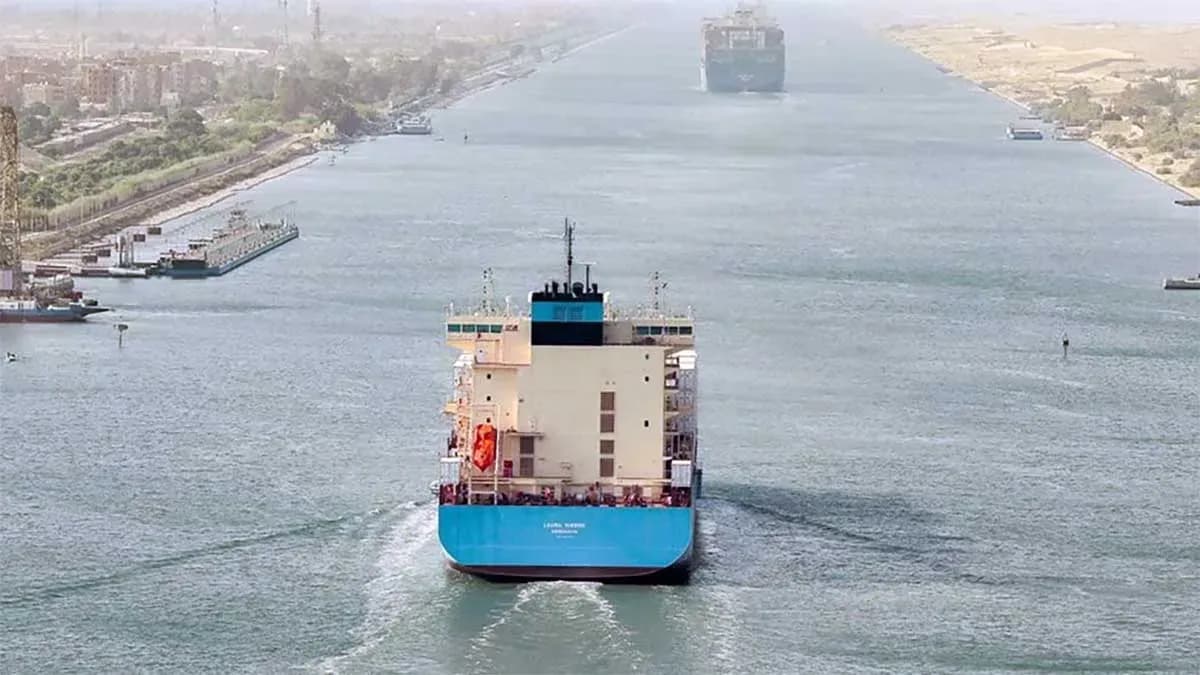
Maersk and Hapag-Lloyd have announced a structural change to the AE15 service, integrated into the Gemini Cooperation, which will operate through the Suez Canal corridor instead of maintaining the alternative route via the Cape of Good Hope. The first departure with this new configuration will be carried out by the vessel Majestic Maersk.
The decision has been made jointly by both shipping companies after assessing the security situation in the area of the Red Sea. According to Maersk, the change constitutes a step towards a gradual return to the trans-Suez corridor, although the company conditions any additional modifications to the Gemini network on the stability of the area and the absence of escalation of conflicts in the region.
The AE15 service connects Asia, the Mediterranean, and Europe, and with the new structure will have the following rotation: Qingdao, Kwangyang, Ningbo, Tanjung Pelepas, Port Said, Damietta, Colombo, and Singapore. The inclusion of transit through Suez modifies the operations that had been developing via navigation around the Cape of Good Hope, a route that has been used by numerous shipping companies since the deterioration of security conditions in the Red Sea.
Maersk has stated that the Suez Canal remains an essential maritime corridor between East and West, as well as a key element for the efficiency of global supply chains. The route through Suez and the Red Sea allows for reduced navigation times compared to the option of the Cape of Good Hope, which involves circling the African continent and incurring greater distances in traffic between Asia and Europe.
The Danish company maintains that the change in the AE15 will allow for more efficient transit times for its customers. The adaptation affects one of the services in the Gemini network and does not currently represent a generalized modification of the entire set of routes in the cooperation between Maersk and Hapag-Lloyd. Both shipping companies maintain specific monitoring of the evolution of security in the Middle East before applying new changes to the network.
The partial return to the Suez corridor comes in a context where major international shipping companies have had to reorganize their services between Asia and Europe over the last few periods due to the risks associated with navigation in the Red Sea. The diversion via the Cape of Good Hope has affected the planning of stops, the availability of vessels, transit times, and operational costs in different logistics chains.
The recovery of transit through Suez in the AE15 is particularly relevant for traffic between Asia, the eastern Mediterranean, and Europe, as it is a service that integrates strategic ports at both ends of the route. Port Said and Damietta, in Egypt, thus regain their role within this rotation, while the Asian ports of Qingdao, Kwangyang, Ningbo, Tanjung Pelepas, Colombo, and Singapore maintain their function in the maritime connection designed by both companies.
Maersk has emphasized that the safety of crews, vessels, and goods of its customers remains the main priority. In this regard, the shipping company has indicated that it has contingency plans in case the security situation deteriorates, making it necessary to reverse specific departures or to more broadly relocate the service to the route via the Cape of Good Hope.
The Gemini Cooperation, developed by Maersk and Hapag-Lloyd, is based on a joint network of ocean services aimed at improving operational reliability and coordination of stops. Any alteration within this structure impacts the planning of shippers, freight forwarders, logistics operators, and port terminals that work with connections between Asia, the Mediterranean, and Europe.
The announcement of the change in the AE15 introduces a sign of partial normalization in the use of the Suez Canal, although the shipping companies themselves have avoided presenting the measure as a complete return to the situation prior to the Red Sea crisis. The implementation of new adjustments will depend on the evolution of regional security and the capacity to maintain stable conditions for commercial navigation.
Maersk has communicated that it will inform its customers when it is in a position to make new modifications to the Gemini network. Until then, the structural change of the AE15 is presented as a concrete measure, subject to ongoing monitoring and with operational alternatives prepared in case the situation requires recovering transit through the south of Africa.