
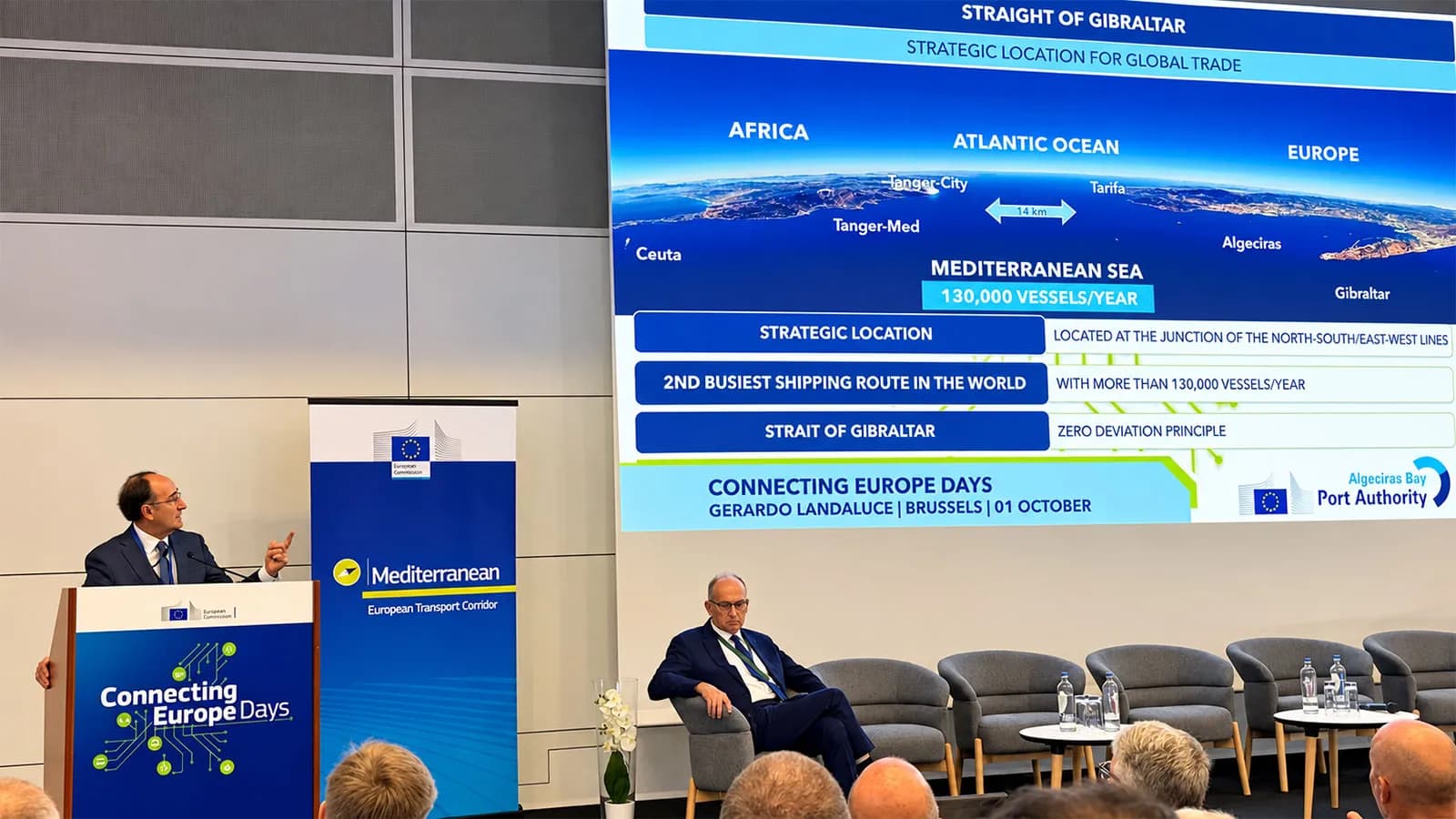
The president of the Port Authority of the Bay of Algeciras (APBA), Gerardo Landaluce, has claimed in Brussels that the competitiveness of European ports should be addressed jointly from the regulatory framework and from the development of land infrastructures. During his participation in the session dedicated to the Mediterranean Corridor of the Connecting Europe Days 2026, he raised the need to review the effects of the European emissions trading scheme (EU ETS) on port activities and complete the necessary railway connections to distribute goods to the interior of Europe.
The intervention took place during a roundtable moderated by the European coordinator of the Mediterranean Corridor, Mathieu Grosch, focused on planning the investments expected in this axis until 2034 and its economic, social, and environmental effects. Representatives from Spain, Italy, Hungary, and Slovenia participated in the meeting, along with the Port of Genoa and the Southern Region of France.
Landaluce pointed out that the application of the ETS is one of the elements that logistics chains are considering in their decisions regarding the location of traffic and new port investments. In this context, he linked European emissions regulation with the increase in capacity being developed by ports located in third countries in the Mediterranean region.
The president of the APBA has argued that the review of the European system must take into account the possible displacement of traffic and activities to facilities located outside the European Union. His proposal aims to prevent regulatory differences from conditioning the decisions of shipping companies, logistics operators, and terminal managers in favor of ports that fall outside the scope of community application.
Land connectivity has also occupied a central part of his speech. Landaluce has presented the existing imbalance between the international maritime connectivity of the Port of Algeciras and the current limitations of its railway connections to the interior of the Peninsula and Europe.
In this area, he has considered it "essential and urgent" to complete the modernization of the Algeciras-Bobadilla line, a segment included in both the Mediterranean Corridor and the Atlantic Corridor of the Trans-European Transport Network. He has also highlighted the development of the Algeciras-Zaragoza railway highway and its continuation to France and Central Europe among priorities.
The president of the port authority has explained that the investments made within port facilities need to be accompanied by land infrastructures capable of channeling the generated traffic. In the case of Algeciras, this connection becomes particularly relevant due to the position of the Strait of Gibraltar within international maritime routes and its role in trade exchanges between Europe and Africa.
Landaluce has presented the Strait as a strategic point for the Mediterranean and Atlantic corridors and has linked the improvement of railway connections with the evolution of international supply chains and nearshoring processes, which bring certain production centers closer to European markets.

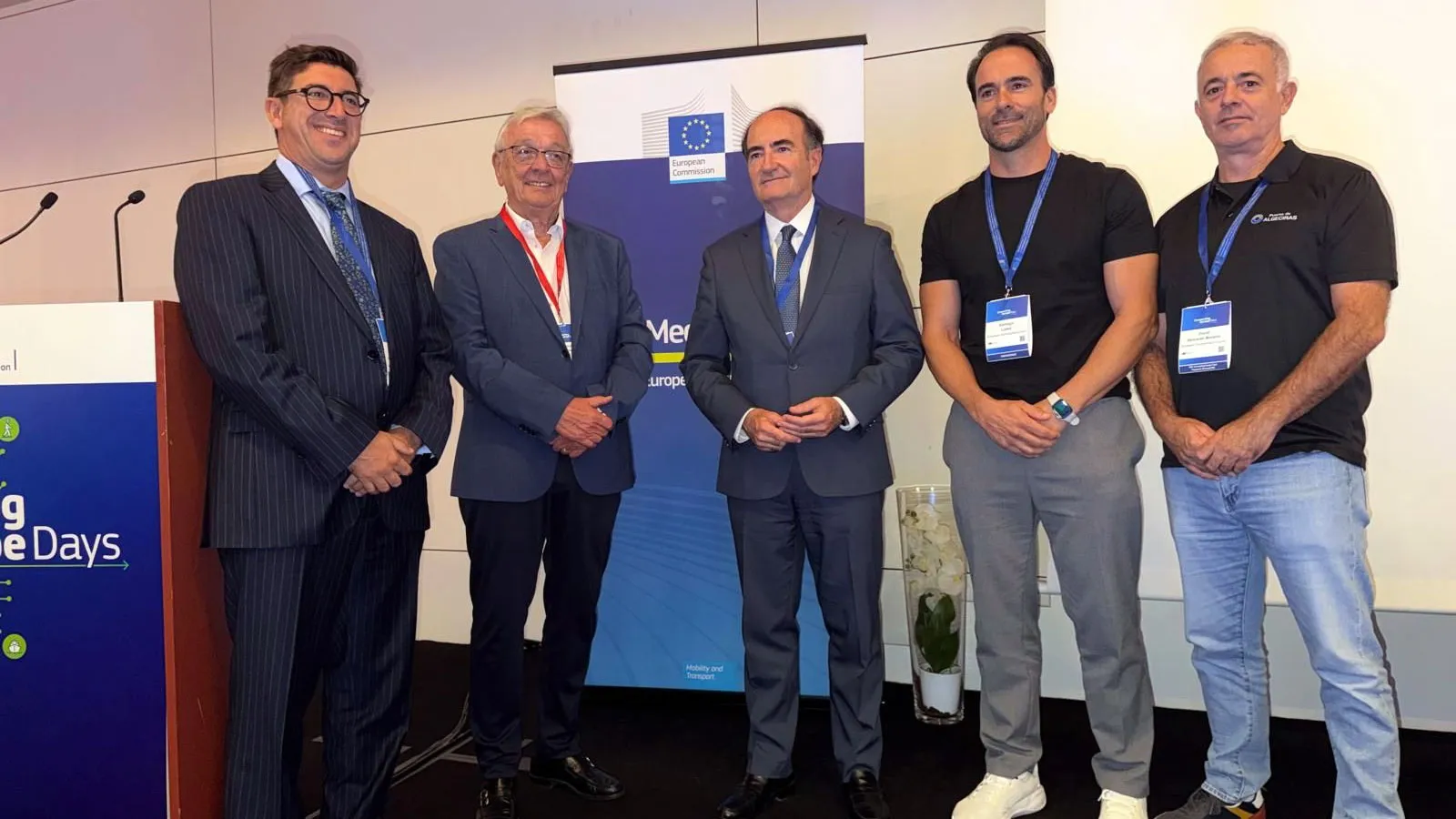
One of the data points used during his speech was the volume of heavy transport that utilizes the maritime connections of the Strait. During 2025, the Algeciras-Ceuta and Algeciras-Tanger Med lines jointly transported more than half a million trucks.
In light of this volume, the president of the APBA has raised the need for a competitive railway alternative that allows part of the goods currently continuing by road to be shifted to the train. This option, he explained during the session, would reduce the pressure of heavy traffic on the main roadway corridors, decrease congestion, and improve road safety and sustainability conditions for transportation.
The railway highway between Algeciras and Zaragoza is part of this intermodal approach. Its development would allow semi-trailers to be transported by rail from the southern peninsula to the Ebro valley and subsequently facilitate the continuity of these flows to France and other European markets.
During the exchange with Mathieu Grosch, Landaluce also addressed the communication of infrastructure projects to the public. He suggested that their evaluation should not be limited to financial criteria, but also incorporate their economic, social, logistical, and environmental effects.
In this sense, he pointed out that the improvement of railway connections affects not only businesses linked to supply chains but also road users through which heavy transport from the ports circulates. The transfer of part of these goods to rail would reduce the presence of trucks on certain routes and modify the modal distribution of transportation.
The session of the Connecting Europe Days has also analyzed the programming of the necessary investments to complete the Mediterranean Corridor by 2034, within the European planning of the Trans-European Transport Network.
In the final part of his speech, Landaluce requested to expedite the execution of pending projects and improve coordination among the different administrations involved, with special attention to environmental procedures that condition the timelines of the infrastructures.
The president of the APBA has argued that the ports integrated into the Mediterranean and Atlantic corridors need to have a railway network connected to the main European logistics nodes to channel goods arriving by sea to the interior of the continent and address exchanges between Europe and North Africa.