
The analysis published in issue 768 of Sea-Intelligence Sunday Spotlight on the deployment of container ships on East-West routes shows a significant change in Gemini Cooperation's operational strategy. The evolution of weekly capacity market share, calculated using an eight-week moving average, indicates that the alliance is modifying its fleet distribution among the main intercontinental routes, with a relative capacity reduction in the Transpacific and in Asia-North Europe, and a notable increase in the Asia-Mediterranean corridor.
The reading of the data allows us to see that it is not just a widespread loss of share against other operators, but a deliberate redistribution of naval resources. Gemini is allocating part of the capacity that it used to employ on specific routes to a greater operational presence in the Mediterranean, where forecasts show growth in its market share during the coming months of 2026. The dashed line included in the graph separates the actual deployment recorded until early June from subsequent forecasts, allowing distinction between capacity already deployed and future planning.
On the Asia-North Europe route, Gemini's share has dropped from 25.7% recorded in mid-May to 22.5% forecast for June 2026. This decline is linked to a structural change in the AE3/NE3 service. After two weeks of blank sailings at the beginning of June, the alliance has resumed this connection with smaller vessels. Ships larger than 18,000 TEUs have been replaced by vessels ranging from 14,000 to 15,000 TEUs, resulting in an approximate reduction of 5,500 TEUs weekly in the capacity deployed in this service.
This adjustment in Asia-North Europe coincides with a contrary modification in the Asia-Mediterranean route. According to data analyzed by Sea-Intelligence, Gemini's capacity share in this corridor would rise from 23.4% to 29.7% in July 2026. The increase corresponds to two operational movements developed during the second quarter of 2026: the launch of a fourth loop, AE19/SE4, with ships of 14,000 TEUs, and the capacity improvement of the AE15/SE3 service, whose average ship size increases from 13,100 TEUs to 18,400 TEUs.
The available information points to a direct cascading fleet mechanism. The 18,000 TEU ships withdrawn from the Asia-North Europe route have been repositioned in the Asia-Mediterranean service, substantially increasing the weekly capacity available on this last route. The estimated net effect is an injection of 22,402 TEUs weekly in the Mediterranean corridor, with a capacity market share reaching 28.1% during the analyzed period.
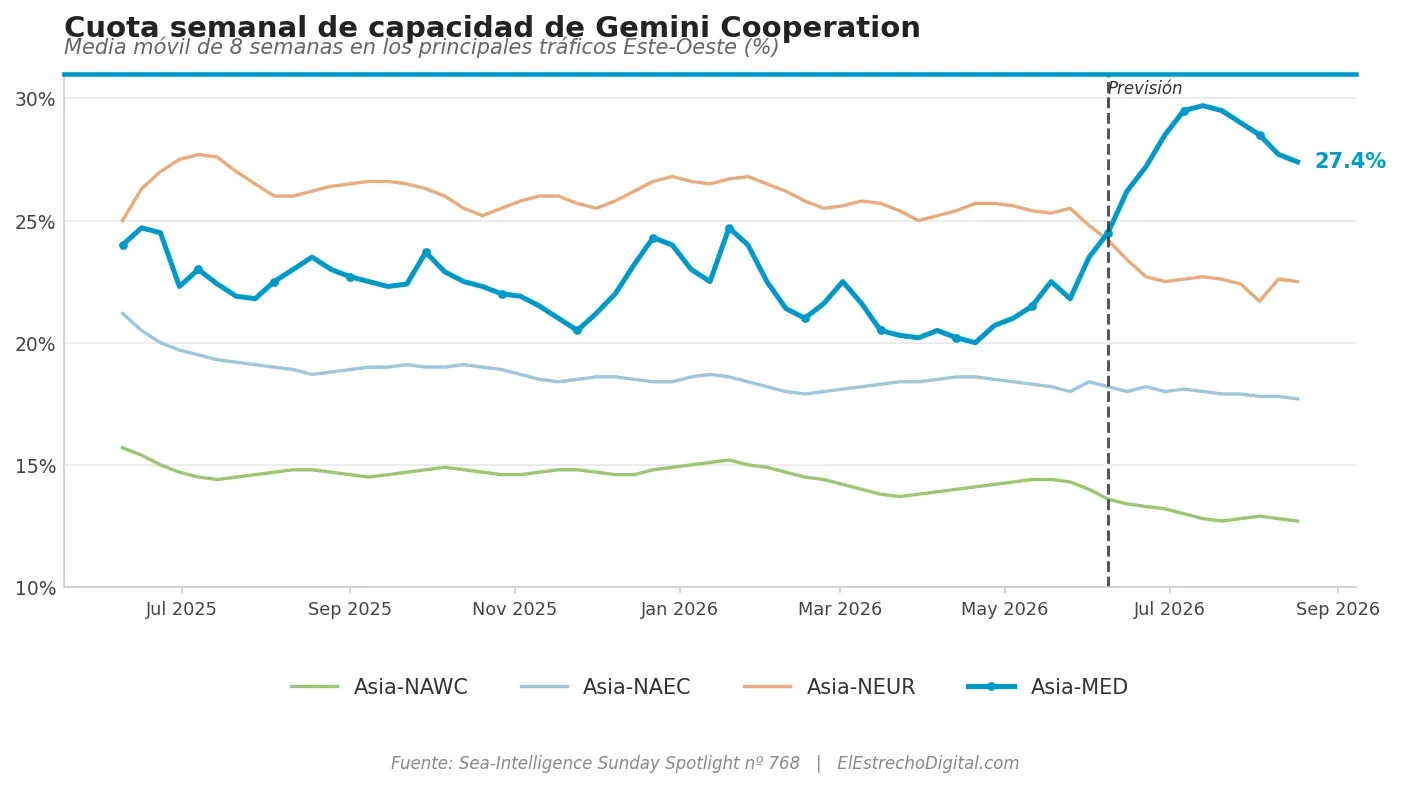
The graph also shows the comparative evolution of Gemini in four major corridors: Asia-West Coast of North America, Asia-East Coast of North America, Asia-North Europe, and Asia-Mediterranean. In the case of the Transpacific, the capacity share remains on a downward path in the two North American variants, although with differences in intensity. Asia-NAWC is below 15% and tends to approach around 13% in the forecasts after June 2026, while Asia-NAEC hovers around 18% and 19%, with a more stable evolution, but also below the initial levels of the series.
The comparison with Asia-Mediterranean is particularly clear. While the Transpacific and Asia-North Europe routes lose relative weight in Gemini's network, the Mediterranean concentrates the largest upward variation. The series shows a steep rise from late April and May, nearing 30% in July 2026. This trajectory makes the Asia-Mediterranean corridor the main destination for additional capacity within the alliance's reorganization.
The movement has operational implications for the Mediterranean port market, as a greater allocation of large capacity ships can modify pressure on terminals, docking windows, feeder services, and inland connections. The use of 18,000 TEU units on services towards the Mediterranean requires more precise planning of calls and operations, especially in ports with high concentrations of East-West traffic. It may also influence competition among Mediterranean ports to attract main services and transshipment connections.
Sea-Intelligence juxtaposes this strategy of Gemini with that of Ocean Alliance, which maintains a more uniform capacity expansion across major routes. Against this model of growth distributed among several corridors, Gemini would be applying a more selective strategy, with a lower share on some routes to concentrate resources in a specific market. The consequence is a denser network in Asia-Mediterranean and a lower relative participation in routes where the alliance has chosen to use smaller ships or reduce weekly capacity.
The expected evolution through August 2026 reflects that the change is not merely a one-time adjustment of sailings but a deeper alteration in fleet allocation. The use of eight-week moving averages smooths weekly variations and allows a clearer view of the underlying trend. In this context, Gemini appears as an operator prioritizing the Mediterranean within its East-West network, with a reorganization of capacity that may have effects on the available supply, shipping competition, and port planning in the coming months.