
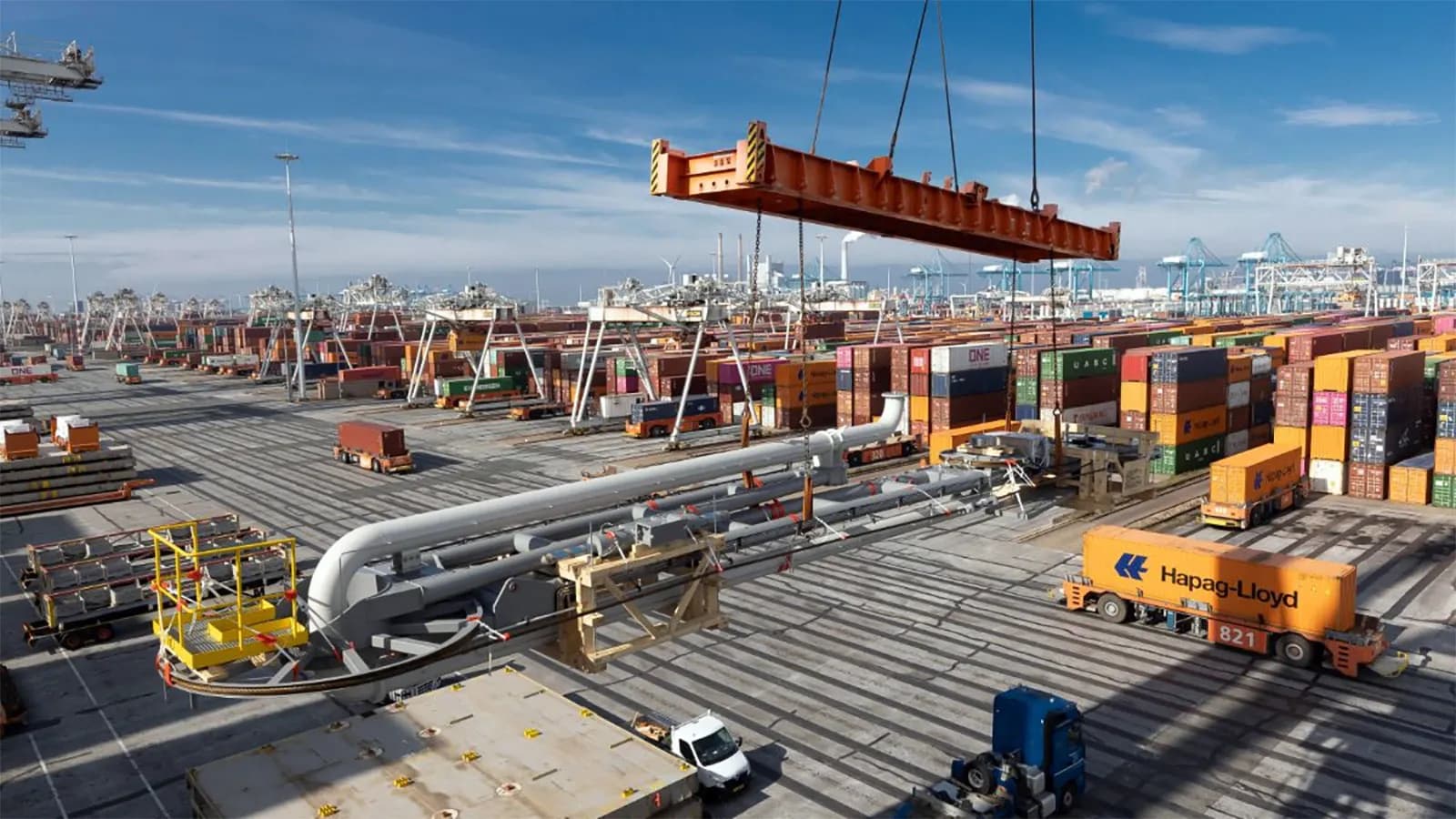
ECT Rotterdam has closed 2025 with an operating result of 136 million euros, the highest since Hutchison Ports acquired the terminal operator in 2002. Revenues reached 714 million euros, compared to 658 million recorded during the previous year.
The increase in revenues has occurred in a context of growth in container traffic in Rotterdam, although CK Hutchison, parent company of Hutchison Ports, has not provided specific figures on the volumes handled by ECT in terms of TEU.
The economic results have coincided with difficulties in the land operations of the terminals. Truck carriers have raised their complaints during 2025 about delays at the accesses, with waits that in some cases have extended for hours to deliver or pick up goods.
In response to the demands of the sector for greater operational capacity, the management of ECT presented at the beginning of 2026 a plan that contemplates the incorporation of additional cranes and the hiring of staff. The company, however, has warned that these measures will not immediately solve the recorded problems.
ECT attributes the operational difficulties to the increase in cargo volumes and the reorganization of international maritime alliances, two factors that have conditioned the activity of the terminals and their terrestrial connections.
The annual accounts also show an increase in the expenses corresponding to outsourced services. This item rose from 22 million euros to 104 million during 2025, which represents a difference of 82 million compared to the previous year.
The available documentation does not fully detail the causes of this increase. Part of the increase could be related to the several-day strike in November by the trincas workers of ILS and Matrans. ECT is the main client of Matrans and was affected by the interruption of activity, as well as by the costs associated with the wage adjustments passed on by the contractors.
In parallel, internal labor costs decreased by one million euros, settling at 216 million. The average workforce of ECT during 2025 was 1,887 workers, 83 fewer than a year earlier. This reduction occurred after the average number of employees had already decreased by 85 people in 2024.
In the main deep-water terminals of Rotterdam, which are part of a network that also includes interior facilities in Moerdijk, Venlo, Duisburg, and Willebroek, the average workforce was reduced by 132 workers between 2023 and 2025, leaving it at 1,719 employees.
The employment evolution during the year was not uniform. Despite the reduction in the annual average workforce, the hiring carried out during the fourth quarter raised the total number of workers at the end of 2025 to 1,985, representing 57 more employees than at the end of the previous year.
Movements in the workforce and the measures adopted to address operational problems also occur during a period of changes in the asset portfolio of Hutchison Ports, during which possible operations on terminals involving MSC and BlackRock are contemplated.
ECT combines its maritime terminals in Rotterdam with interior facilities that connect the main Dutch port enclave with other European logistics centers. The evolution of its results during 2025 has thus occurred parallel to increasing pressure on land operations, the growth of outsourced service costs, and the changes recorded in its workforce.