
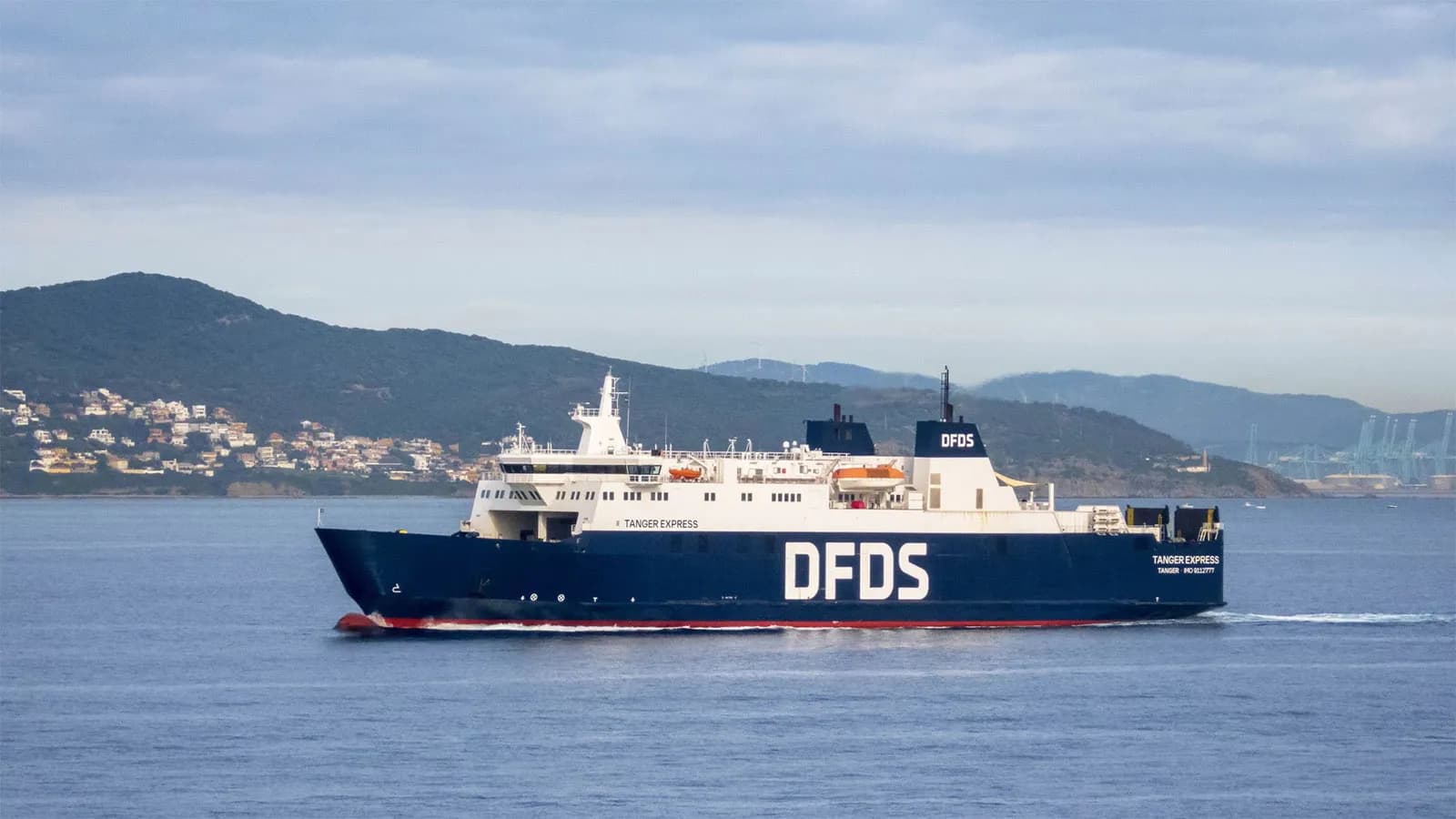
DFDS closed the second quarter of 2026 with a 2.4% growth in its cargo volumes in the Strait of Gibraltar compared to the same period of the previous year, within a quarter in which the group increased its revenues by 9.9% and significantly improved its operating result. The financial report published by the company provides specific activity data for the Strait, although it does not break down the revenues or results specifically related to this market.
Between April and June, DFDS accounted for 584,000 linear meters of cargo in the Strait, compared to 570,000 in the second quarter of 2025. In the first six months of the year, the volume reached 1.251 million linear meters, compared to 1.210 million between January and June of the previous year.
The evolution of passenger activity was different. DFDS indicates that the adjusted volumes in the Strait decreased by 24.8% during the second quarter, due to a lower number of departures caused by weather-related disruptions and changes in tonnage during the period.
In unadjusted terms, the company recorded 134,000 passengers in the Strait between April and June, compared to 228,000 in the same quarter of 2025. During the first half of the year, there were 257,000 passengers, compared to 495,000 in the first six months of the previous year. The comparison is conditioned by DFDS's exit from the Tarifa-Tangier Ville route at the beginning of May 2025, which led the group to also offer an adjusted comparison of passenger evolution.
The Strait constitutes one of the three areas of DFDS's Ferry Division where goods and passenger traffic are combined, along with the English Channel and the Baltic Sea. The North Sea and the Mediterranean, for their part, are exclusively oriented toward the transport of goods within the structure with which the group presents its results.
Data from the Strait are part of a second quarter in which total cargo volumes for DFDS's ferry network increased by 1.1%. The North Sea recorded a growth of 5.5% once route changes were adjusted, while Mediterranean traffic decreased by 3.3%. In this last market, the growth of connections between Egypt and Tunisia with Europe did not offset the decrease recorded between Turkey and Europe, attributed by DFDS to capacity adjustments and more contained demand in both European and Turkish markets.
The report also incorporates information about the operation through which DFDS plans to incorporate part of Naviera Armas Trasmediterránea's activities in the Strait of Gibraltar. The company recalls that the agreement was announced in August 2025 and establishes an acquisition price of approximately 32.1 million euros. This amount is not included in DFDS's investment or cash flow forecasts for 2026.
DFDS notes in the documentation pertaining to the second quarter that during the third quarter of 2026 it received a conditional authorization for the transaction and that it continued dialogue with the competent competition authorities. The closure of the operation remained, as of the date of the report's preparation, subject to final regulatory approvals.
The operation announced in 2025 involves the acquisition of two vessels linked to services between Algeciras and North Africa, along with the corresponding permits and the incorporation of around 200 crew members. The Spanish file affects the activities that Armas develops on the Algeciras-Tangier Med and Algeciras-Ceuta connections.
For the Ferry Division as a whole, second-quarter revenues increased by 13.4%, from approximately 577 million to 654.3 million euros. The result before interest, taxes, depreciation, and amortization reached about 124 million euros, compared to 93.9 million a year earlier, with an increase of 31.9%, while the operating result rose from 24.9 to 56.6 million euros, an increase of 127.5%.
DFDS attributes part of the increase in freight transport revenues to the rise in surcharges for fuel applied during the quarter. The company also explains that the rise in oil prices recorded since March initially generated additional costs due to the time lag between fuel price fluctuations and their transfer to cargo rates, an effect that turned positive during the second quarter.
The result of the Ferry Division includes an extraordinary cost of approximately 7.1 million euros arising from a French court ruling related to the chartering of two ferries in the English Channel in 2015. Adjusted for route changes and extraordinary items, DFDS estimates the year-on-year increase in the operating result of this division at around 35.9 million euros.
At the group level, DFDS obtained approximately 1.148 billion euros in revenues between April and June, compared to 1.045 billion in the second quarter of 2025, representing a 9.9% growth. The result before interest, taxes, depreciation, and amortization increased by 34.9%, from approximately 119.5 million to 161.2 million euros, as a result of better results in its two operating divisions.
The group's operating result reached approximately 60.7 million euros, compared to 21.8 million a year earlier. The improvement amounts to about 38.9 million and represents a year-on-year increase of 179%. The margin before depreciation and amortization rose from 11.4% to 14%, while the operating margin stood at 5.3%, compared to 2.1% recorded in the second quarter of 2025.
The result before taxes reached approximately 32.1 million euros, around 38.9 million more than in the second quarter of the previous year. After accounting for a tax expense equivalent to about 9.6 million, the net profit for the period stood at 22.5 million euros, compared to the losses recorded a year earlier.
For the entire first half, DFDS's revenues amounted to approximately 2.132 billion euros, 3.8% more. The result before interest, taxes, depreciation, and amortization reached about 268.1 million, 22.1% above the same period in 2025, while the operating result stood at 65.1 million euros, compared to about 6.2 million in the previous first half. The accumulated net result remained slightly in negative territory, with losses approaching one million euros, compared to about 55.5 million in negative recorded between January and June of 2025.The Logistics Division also improved its results during the second quarter. Revenues increased by 7.8%, from approximately 521.3 million to 561.9 million euros, while the result before interest, taxes, depreciation, and amortization rose from 29 to 40.3 million. The operating result reached 11.4 million euros, compared to 4.4 million in the same period of 2025, representing an increase of 157%.
DFDS links this evolution mainly with the units from continental Europe and the Nordic countries. In its continental network, the group applied cost control measures and capacity adjustments, while several projects called Boost, aimed at activities with results below the company’s targets, maintained their impact during the quarter.
The improvement in results is framed within the six actions defined by DFDS at the beginning of the year to act on its operating result: recovery of the Mediterranean, ramp-up of Jersey operations, pricing policy for cargo ferries, Boost projects in Logistics, completion of the cost reduction program initiated in 2025, and recovery of the Türkiye & Europe South (TES) unit.
Cash generation also increased during the quarter. Cash flow from operating activities reached approximately 165.9 million euros, 17.9% more than in 2025. Adjusted free cash flow stood at around 97.4 million, compared to 72 million a year earlier, and reached 137.5 million in the accumulated first half.
DFDS explains that the evolution of working capital during the second quarter was influenced, among other factors, by seasonal passenger advances and by the receipt of amounts corresponding to the European emission trading scheme, ETS, which will be paid to the European Union during the third quarter.
The company therefore anticipates that the adjusted free cash flow will be negative during the second half of the year as a result of the reversal of passenger advances, ETS payments, and a level of investment higher than that recorded during the first half, including the acquisition of a ferry.
DFDS maintains its investment forecast for 2026 at approximately 227.4 million euros, compared to around 133 million recorded in 2025. Among the planned operations is the purchase in November of the Stena Vinga, a RoPax built in 2005 that is currently operated chartered by DFDS on the connection between Jersey and Portsmouth.
The evolution of results and cash has also reduced indebtedness. Net financial debt was approximately 1.873 billion euros at the end of June, about 281 million less than a year earlier and 160.5 million below the close of 2025. The ratio of net financial debt to the result before interest, taxes, depreciation, and amortization for the last twelve months fell to 3.4 times, down from 4.2 times at the end of the second quarter of 2025 and 4.1 times at the end of the previous year.
DFDS now expects to finish 2026 with this ratio around 3.5 times, compared to its previous estimate of bringing it below four times. For the end of 2027, it maintains a forecast of below 3.5 times. The structure between debt and equity stood at a 50/50 ratio at the end of the second quarter, compared to 54/46 a year earlier.
The results of the first half have led the group to revise its forecasts for the entirety of 2026 upwards. DFDS currently expects revenue growth of between 3% and 5%, compared to the previous estimate of remaining approximately at 2025 levels. The company mainly attributes the modification of this forecast to the increase in surcharges for fuel both in maritime and road transport.
The expected operating result for the entire year now stands between approximately 160.5 and 187.3 million euros, after raising the lower limit of the forecast from about 133.8 to 160.5 million. For the Ferry Division, the range is approximately between 173.9 and 194 million euros, while Logistics operates between 20.1 and 26.8 million. The expected adjusted free cash flow for the entire year rises to around 66.9 million euros, compared to a previous forecast higher than 33.4 million.
The update maintains various uncertainty variables for the second half of the year. DFDS is operating from a forecast of European economic growth close to 0.5% in 2026 and points out among the factors that may affect activity the evolution of the conflict between Iran and Gulf countries, the level of oil prices, the war in Ukraine, and other geopolitical events.
Regarding goods transport, the company expects ferry volumes between Europe and Turkey and North Africa to continue growing during the second half of 2026, although high oil prices may affect certain markets. For northern and eastern Europe, it generally expects similar levels to those recorded in 2025 during the remainder of the year.
Since the beginning of March, DFDS has registered a rise in oil prices and maritime fuel differentials. Volatility has increased the existing lag in the mechanism by which fuel costs are transferred to goods transport. The company has increased coverage for a larger portion of these differentials for the rest of the year.
The new president and CEO of DFDS, Michael Hansen, who took office on July 1, has simultaneously initiated a review of the company’s strategy. The process will address the long-term vision, positioning, priorities, and financial objectives of the group and is expected to conclude within six months.
In environmental matters, the equivalent CO₂ emission intensity of the entire network increased by 2% during the second quarter, from 13.9 to 14.2 grams of CO₂ per gross ton and nautical mile. DFDS relates this variation to a higher engine load as capacity concentrated on a smaller number of vessels and with higher sailing speeds to meet demand. In absolute terms, the well-to-wake emissions of the entire network decreased by 2.3% during the first half compared to 2025, due to the use of fewer ships, fleet optimization, and a lower number of departures.