
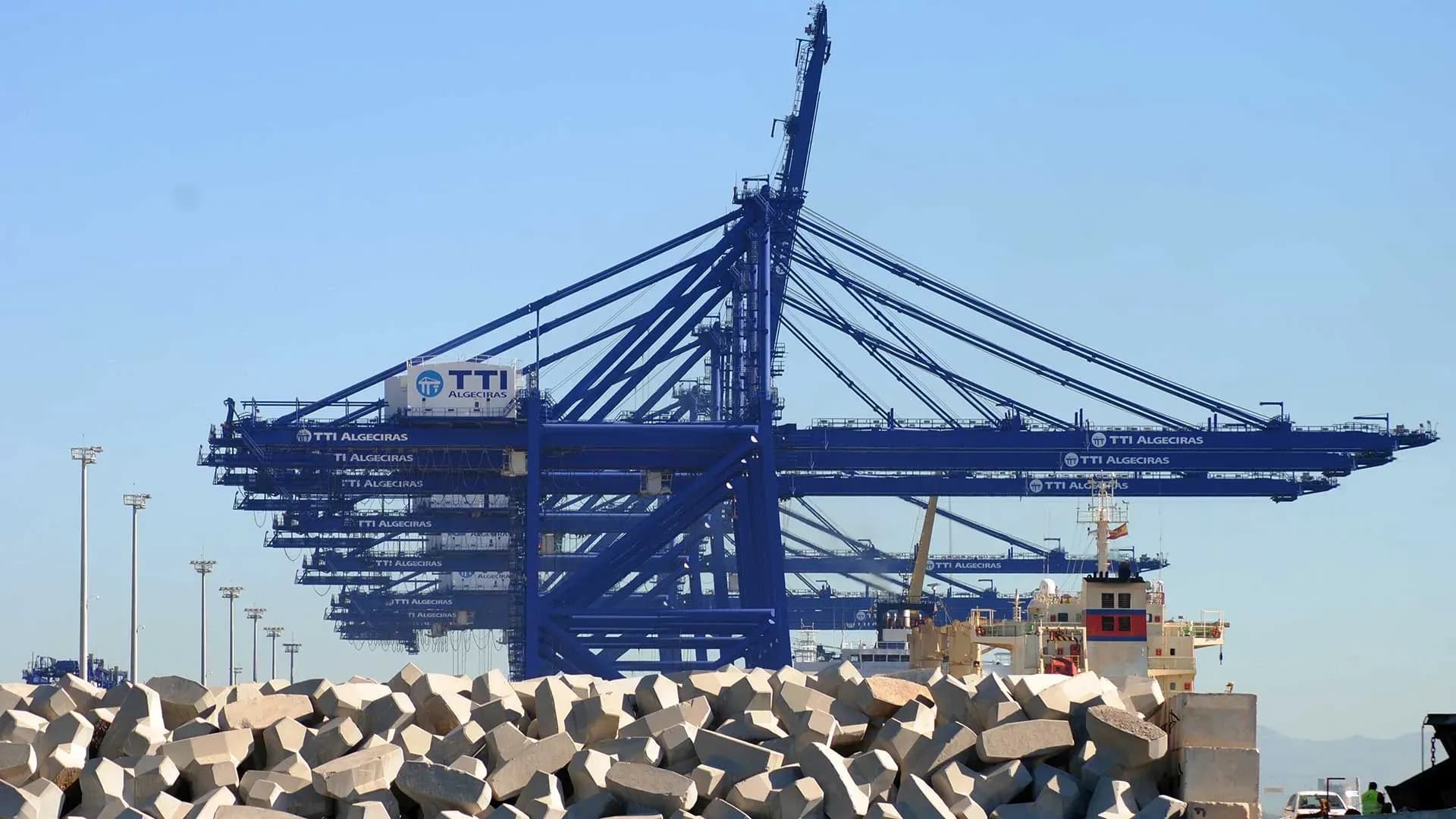
The Port of Algeciras Bay has been situated for years among the four major European ports alongside Rotterdam (Netherlands), Antwerp (Belgium), and Hamburg (Germany). Its strategic location in the Strait of Gibraltar, one of the busiest waterways in the world where the main East-West and North-South maritime routes converge, makes it a central node for maritime transport in the western Mediterranean. With direct connections to 200 ports around the world, serviced by 142 regular routes and 23 shipping lines, and with a nearly non-existent deviation from the main navigation routes, Algeciras also functions as an intercontinental point between Europe and Africa, with a significant ro-ro traffic across the Strait. Behind these figures lies a complex labor reality, shaped by the action of a union that has managed to become the majority organization in the port area: the State Coordinator of Maritime Workers (CETM).
A joint investigation by the University of Cádiz and the University of Oslo, carried out by researchers Nazaret Castro Buzón, Hege H. Heivestad, and Beltrán Roca, and published in the journal Cuadernos de Relaciones Laborales, has thoroughly analyzed this process of union renewal. The study, based on qualitative interviews, documentary analysis, and field ethnographic work conducted between 2018 and 2024, reconstructs the trajectory of a union that was born in 1979 linked to stevedores and that, starting in 2009, expanded to encompass all port labor sectors, displacing the hegemony that CCOO and UGT had maintained for decades in most of the companies at the Port of Algeciras Bay.
The port operates under a landlord port management model: the planning and basic infrastructure correspond to the Port Authority of Algeciras Bay, while terminal operators and industrial companies have long-term lease contracts. Algeciras operates with two container terminals, APM Terminals and TTI Algeciras. The latter, the first semi-automated terminal in the Mediterranean and southern Europe, began its commercial activity in 2010. After the bankruptcy of the South Korean Hanjin in 2017, TTIA became property of the South Korean shipping company HMM and Isla Verde Algeciras Terminal Holding. In addition to these two large terminals, a wide range of services and activities are offered: mooring, piloting, towing, Marpol, agencies, ship repair, supplies, horizontal transport, cargo dispatch, customs, border control, and warehousing. An economic impact report prepared by the University of Cádiz and published in 2014 by the Port Authority estimated that more than 28,000 jobs directly or indirectly depended on the port, figures debated within the local community but that position the Algeciras Bay Port as the largest employer in the Campo de Gibraltar area.
Algeciras has the largest contingent of stevedoring personnel in Spain, with around 2,000 employees. Union membership among stevedores is almost entirely concentrated in the State Coordinator of Port Stevedores (CEEP). This union, founded in 1979 in the context of an economic, political, and social crisis following the Francoist dictatorship, distanced itself from the major union centers from its origins and developed a distinct identity, inheriting the autonomous struggles of the Transition, focused on the organization and professionalization of stevedoring work.
This identity was particularly visible during the massive mobilizations of 2017, when the Spanish port sector was plunged into a crisis due to the implementation of liberalization reforms demanded by the European Union, which the conservative Government initiated without dialogue with the majority stevedoring union. In Algeciras, the streets filled with workers dressed in orange and supporters during the strike days, and the protests occupied a central place on the political agenda.
In Algeciras, many veteran stevedores who joined the port in the 90s were welcomed by a strong local fraction of Coordinator, which proved crucial for their professional formation and for the construction of a collective identity. Coordinator, by getting involved in hiring, training, and safety tasks at the docks, plays a central role in the training of port personnel. Through personal relationships, anti-bureaucratic practices, and a personal commitment from union representatives, the union fosters a sense of internal solidarity where the organization is presented as a 'family'. The identity as a worker of the port is inseparable from the affiliation to the union, and this identity formation has an intergenerational component, with values transmitted among family members and friends.
With the turn of the century, stevedoring unions had resisted the attempts at liberalization by various Governments in Spain. Although they had secured the exclusivity of stevedoring collectives in each port to carry out stevedoring tasks and had control over hiring, automation processes were diminishing the influence and number of stevedores across the Spanish ports. In Algeciras, increased traffic and the opening of the Isla Verde terminal in 2010 allowed for an increase in staff, but nationally the trend was one of numerical decline. Several leaders of Coordinator then perceived the need to expand the organization to other port labor sectors.
The turning point occurred in 2009, when non-stevedoring port workers approached Coordinator to request support. From that contact emerged the idea to create a new union structure to represent other collectives: piloting, mooring, towing, shipping companies, agencies, port authorities, cleaning, and other trades. On July 2, 2009, the State Federation of Port Workers (FETP) was established in Madrid, with participation from staff of the ports of Barcelona, Valencia, Algeciras, Las Palmas, Tenerife, and Bilbao, although the initiative had initially come from personnel in the Canary Islands and Levante. In November of that year, the first Assembly was held in Valencia, where the organizational foundations were laid. The FETP, along with the CEEP of stevedores, became part of the State Coordinator of Maritime Workers (CETM).
In October 2010, during the II Congress held in Bilbao, the union already represented nearly 1,000 affiliated individuals, mostly from other union organizations. In Andalusia, the new structure began gaining representation in union elections in 2012, with 25 affiliates and four delegates. Ten years later, in 2022, the numbers had escalated to 913 affiliates and 96 delegates in the autonomous community. At the state level, delegates increased from 80 in 2012 to 219 in 2022, and affiliates from 804 to 2,164 in the same period.
In November 2012, the Coordinator of Workers of the Ports of the Campo de Gibraltar was established, with a presence in companies such as Imtech, Medes, and APM Terminals. From there, the expansion in Algeciras was continuous. In 2015, Coordinator participated in a ten-day strike at APM Terminals regarding the adaptation of the provincial metal agreement, signed the first Horizontal Transport Agreement, and organized a demonstration against the privatization of baggage handling services at the Port Authority. In 2016, it collaborated with the SAME union in a conflict in the mooring sector that affected 57 workers and was resolved with an agreement that provided stability and wage improvements.
In 2018, union action focused on the auxiliary companies of APM Terminals —Kalmar, Urbaser, and Álvarez Núñez, responsible for maintenance, cleaning, and repairs— where Coordinator held the majority of union representation and managed to sign agreements to improve the conditions of the 240 people they employed. In 2019, the union won elections at the forwarding company Partida Logistics and concentrated its priorities on the precarization of mooring, the lack of personnel at the Border Inspection Post, and the situation of mechanical operators. In 2020, it obtained four of the five representatives at Maritime Terminals of the Strait and signed the collective agreement of the Corporation of Pilots.
The year 2021 was marked by the pandemic context. Coordinator called on Port Authority for an increase in the replacement rate within the port authorities and spoke in favor of the inspectors of External Health at the Border Control Points, who faced a huge workload with ensuing delays in goods. At the Port of Algeciras, workers from the Port Authority gathered to demand the salary update agreed upon in the state collective agreement. Threats of strike were recorded in underwater repairs at UCS, led by the Coordinator of Workers of the Andalusian Ports (CTPA), and at APM Terminals, led by CCOO. In both cases, agreements were reached before work stoppages occurred. There were also mobilizations at OHL Algeciras, subcontracted by the Port Authority for cleaning, and violations were reported to the Labor Inspection regarding rest conditions in transit companies and customs agencies. Coordinator managed to secure delegates in the Port Authority, Algeciras Jet, UCS, Urbaser, and Global Logistics.
In 2022, Algeciras solidified its central territory for the port union. At the state level, Coordinator joined the State Tugboat Platform, which also includes CGT, CNT, USO, SAME, CIG, OTEP, and SITRAMAR, which denounced labor law violations by tugboat companies. In the Algeciras port, the union participated in negotiations for APM Terminals' agreement to guarantee jobs amid the transfer of activity to other ports, negotiated with the Port Authority on employment offers and activity regulation, and held assemblies with workers at the Border Control Point, who began to organize to demand a productivity bonus. The electoral victories in Tránsito 2000 and FESAVALA S.L. represented, according to the union's own Yearbook, their consolidation as the 'majority union of the Port of Algeciras.' This growth allowed displacing CCOO and UGT in the maritime agency sector and becoming the strongest force in negotiating the provincial sectoral agreement in 2023. That same year, Coordinator became the most voted organization in elections at APM Terminals. By the date of the investigation, CTPA had more than 110 delegates in the Andalusian port companies, the majority in the Port of Algeciras, and held representation in almost all companies in the port.
The investigation identifies two main axes that underpin this process: union action at multiple scales and the construction of territorial power over the port space. As for multiscalarity, Coordinator has operated simultaneously at the supranational level —through its participation in the International Dockworkers Council (IDC) and, since 2021, after an internal split, in the European Dockworkers Council (EDC)—, at the European level —with strike days and demonstrations in Brussels against port regulations—, at the state level —leading the opposition to the liberalization of ports— and at the local level, where collective bargaining is articulated in a multi-level system that combines sectoral framework agreements with agreements at the company or port level. In 2015, for example, federation members joined a 24-hour state strike against a European regulation that would allow foreign ships to perform towing tasks in Spanish ports.
Collective bargaining is complemented by the mediation of the Port Authority, the Labor Inspectorate, judicial recourse, and the media. The union selects the levels of action and negotiation based on each moment and each conflict. An example is the case of the Corporation of Pilots, where employers differentiated the conditions between the 'boteros' or fleet personnel and radio operators. Coordinator's effort focused on uniting both collectives under a single agreement to gain leverage. 'I am in favor of, even if we are different departments, everyone should at least have the same social rights, the same shifts,' explained a union representative of the CTPA in the corporation of pilots at the Port of Algeciras.
The second main axis, territorial power, is built according to the research on five pillars. The first is intraport solidarity. Initially concentrated in the stevedore collective, from 2009 that solidarity has been extending to all port labor sectors. 'They wanted to transfer that philosophy because they had succeeded,' explained a union representative of the Border Inspection Post, adding that 'they understood and saw beyond that the port was not just about stevedoring, but that other collectives had quite relevant importance.' This solidarity manifests itself primarily in mutual support in the event of labor conflict. 'When it came to the PIF, we called on all collectives: mooring, towing, piloting, mechanics,' recounted a CTPA representative at a mooring company. A union delegate at a maritime agency expressed it this way: 'You feel like a worker of the port, not of your particular company, but of the port many times.'
The interviewed unionists pointed out that they received requests for support from non-port workers, but they claimed that the statutes did not allow them to affiliate them and that the union activity within the port already absorbed all their capacity. Nevertheless, Coordinator expressed support in labor conflicts in the area, such as the 2021 strike in the metal sector and the strike at Acerinox in Los Barrios in 2024.
The second pillar is organizational horizontality. Coordinator defines itself as assembly-based, with constant communication with workers and no union representatives. 'You lose that essence and that commitment and being with the workers day to day,' explained a representative of the Border Inspection Post, noting that 'in the end, the one negotiating the agreement was someone who was not a port worker, who did not know the problems in depth. And in the end, it doesn't hurt one the same way.' A delegate at a maritime agency described the difference with the majority unions: 'Only when the agreement was negotiated many years ago did they go to Cádiz. They would disappear for a few days and then show up and tell you: 'You'll find out when it's published.' So here everything is much more direct.'
The third pillar is the orientation towards conflict, with a strategic use of strikes as a pressure tool in collective bargaining. The interviewed CCOO unionists, on the other hand, criticized this line as 'irresponsible' and 'uncooperative.' Coordinator adapts its tactics to the context: when the strike is not effective in certain sectors, action focuses on legal avenues and reporting to the Labor Inspectorate. 'We know which does damage and which does not. But if it's companies that won't have a negative impact, what we do is handle it via legal means. We use the Labor Inspectorate a lot,' explained a union representative from a towing company.
The fourth pillar is union control over labor markets. In stevedoring, employment pools have historically been negotiated between the union and the companies, articulated through different legal figures: first the Port Stevedores Management Society (SAGEP) and today the Port Employment Centers. Beyond stevedoring, the public concession system of the Port Authority, along with labor laws regarding business succession and the subrogation clauses of collective agreements, provide stability to personnel when concession companies change.
The fifth pillar is the qualification of port trades. The introduction of containers and specialized cranes enabled the professionalization of stevedoring jobs. The Port Employment Centers, besides managing job pools, also have ongoing training among their functions to adapt to technological changes. The highly specialized nature of many port tasks, such as mooring, piloting, or towing, and the difficulty in automating them, are factors that, according to the research, contribute to workers' bargaining power.
The research, funded by the Ministry of Science, Innovation, and Universities within the SPATIALPOLITICS project on labor politics in the logistics industry, was informed by two distinct ethnographic projects. One of them, executed between 2022 and 2026, included 12 interviews with workers and unionists from Coordinator, CCOO, and CGT, as well as observation sessions at union events and a participatory workshop to construct a counter-cartography of the port area. The second, developed between 2018 and 2024, focused on logistic work, unionism, and port-city relations, with participant observation and interviews with actors from multiple sectors: stevedores, pilots, customs, agencies, storage, border control, port authority, and horizontal transport.
The study indicates that port personnel from the Port of Algeciras Bay, particularly from stevedoring, are aware of the challenges posed by the current international context: automation and competition from the port of Tangier, which has seen exceptional recent growth, could limit the bargaining power that workers have had to date through strategic use of strikes. The expansion of the union to other port sectors, with the creation of the State Federation of Port Workers (FETP) since 2009, has incorporated not only personnel from services where wage conditions had been more precarious, like mooring, but also other trades developed in the port, often feminized and precarious, such as chambermaids and cleaners. Through the mooring companies, Coordinator also expands to other ports in the Andalusian community.
The research published in Cuadernos de Relaciones Laborales documents, ultimately, how a union born in 1979 to represent stevedores managed, starting in 2009, to expand to encompass all labor sectors of the Port of Algeciras Bay until becoming the organization with the highest representation in the port area. This process, according to the study, is supported by a combination of union action deployed at multiple scales —from the European level down to each company— and the construction of territorial power based on five pillars: intraportal solidarity, organizational horizontality, conflict orientation, union control over labor markets, and qualification of port trades. In Andalusia, Coordinator went from 25 affiliates and four delegates in 2012 to 913 affiliates and 96 delegates in 2022. At the state level, the number of delegates grew from 80 to 219 and affiliates from 804 to 2,164 in the same period. The port of Algeciras, the busiest in Spain and one of the four largest in Europe, has consolidated itself as the central territory of this port union, which, according to the data collected by researchers, holds representation in almost all companies in the area and leads the main labor conflicts and collective negotiations.
Recent developments of the union
Following the period analyzed by the research, Coordinator's trajectory in the Port of Algeciras has continued to add relevant chapters. In June 2025, Coordinator held its VI Confederational Congress in Tenerife under the slogan 'With determination, towards the future', with the participation of more than 240 union delegates from all over Spain. At that meeting, Antolín Goya presented his management report and the project for the period 2025-2029, opting for reelection as general coordinator of the CETM, an organization that according to the union's own data represents more than 9,000 workers from various sectors of the state port system. Simultaneously, the VI Congress of the State Coordinator of Port Stevedores (CEEP) and the V Congress of the State Coordinator of Workers of the Ports (CETP) were held, with discussions on the evolution of the structures, trade union and professional training, and strategy in light of legislative and technological changes.
In the Port of Algeciras, the summer of 2025 was marked by the conflict in the Pilot Corporation. After months of unsuccessful negotiations, the fleet and radio services staff voted overwhelmingly in favor of the strike: 34 of the 47 workers voted for the stoppages, four opposed, and the rest abstained. Workers formally communicated the pre-strike notice for the period from July 20 to August 20, 2025, during the ongoing Operation Crossing of the Strait, with stoppages planned in three daily time slots. Among the demands were the reduction of workload, adequate rest times, an increase in staff, and an annual salary increase of 6.5% for 2025, 2026, 2027, and 2028 due to the accumulated loss of purchasing power. The strike was eventually called off after a last-minute agreement was reached.
In October 2025, Coordinator won the union elections at the Port Authority of Algeciras Bay, the only entity in the port area where it had not yet achieved a majority position. The union obtained 158 votes, ahead of UGT with 151, CCOO with 42, and CSIF with 19, which the union described as a 'historic result'. Coordinator achieved for the first time six delegates in the Works Council of the APBA, continuing a progression that saw it go from four delegates in 2017 to five in 2021.
In March 2025, Coordinator TPA also won the union elections at the container deposit company Docks Logistics in the Port of Algeciras, according to the union's own report. Also, a pre-agreement was reached between the radio staff and the Pilot Corporation of the Port of Algeciras.
At the European level, in February 2026, representatives of Coordinator from the Port of Algeciras attended the presentation in Brussels of a report on the impact of the emissions trading system (ETS) in the ports of the European Union, prepared by Ports of the State, conveying concerns about the consequences of the ETS on the employment of port workers.
Finally, this same week, the stevedores of the Port Employment Center (CPE) of Algeciras elected the 25 representatives of the new works council of Coordinator in a primary election held at the José Arana Port Training Center. Of the 2,000 stevedores who make up the census, 1,498 went to the polls, resulting in a participation rate of 75%. A total of 216 candidates ran in the elections, and 17 of the 25 elected representatives were repeat candidates from the previous council, reflecting a broad continuity in union representation.