
The decarbonization of maritime transport has consolidated the framework of cooperation between the Port of Algeciras and the Panama Canal Authority, two strategic enclaves for international routes between Europe, Latin America, and the main global markets. This relationship is articulated through the Panama-Algeciras Green and Digital Maritime Corridor, an initiative aimed at facilitating the energy transition of the sector and contributing to the international goal of achieving net zero emissions by 2050.
The cooperation between both institutions has allowed the Panama Canal Authority to develop its decarbonization roadmap and a feasibility study with support from the European Union. These efforts are integrated into the Global Gateway strategy, a community tool aimed at improving international connectivity and relationships with strategic partners, with particular attention to Latin America.
The president of the Algeciras Bay Port Authority, Gerardo Landaluce, has positioned this collaboration within a broader strategy between Europe and Latin America, with Algeciras and Panama as connection points for maritime transport, logistics, and energy transition. Additionally, this framework is in the process of expansion with the future incorporation of Colombia, a country that maintains a growing relationship with both enclaves in logistics and energy matters.
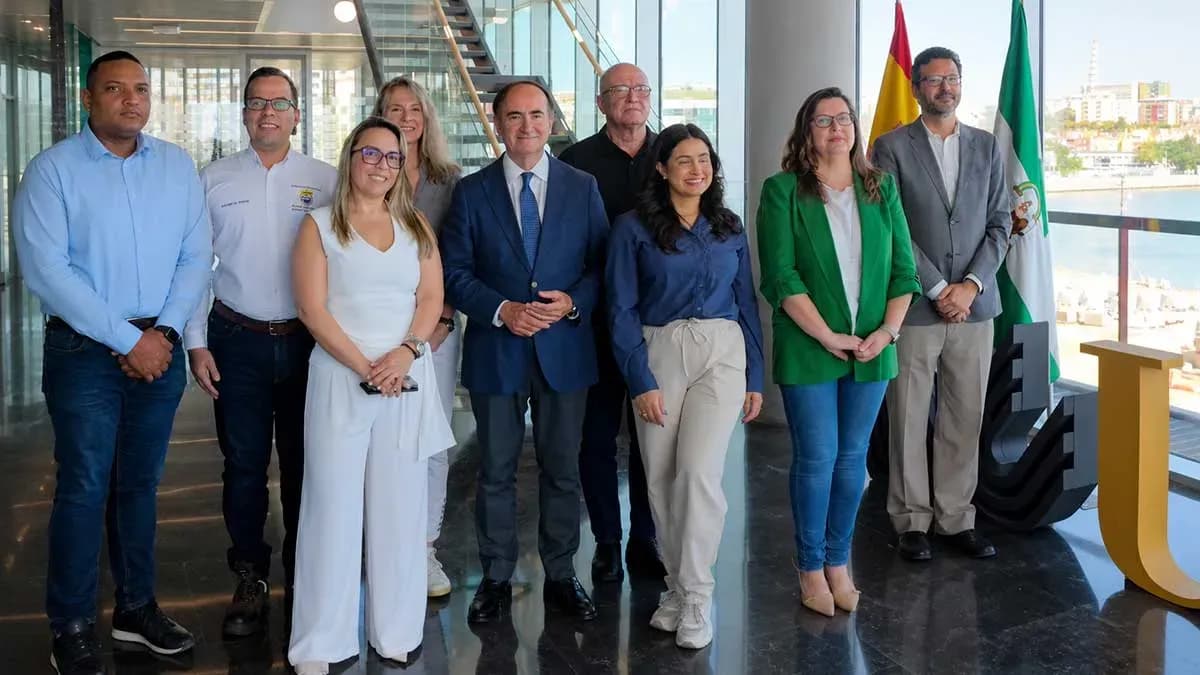
In this context, a Panamanian delegation is participating these days in Algeciras in a seminar organized by the APBA. The meeting brings together terminals, companies from the port community, and business representatives from Panama, Colombia, and Spain to share projects related to electrification, energy efficiency, and emission reduction in port and maritime activities.
The UCA Sea building of the Maritime Lake of the Port of Algeciras hosts this international workshop this week, focused on the implementation of electrification projects for docks and terminals within the Panama-Algeciras Green and Digital Maritime Corridor. Nearly fifty sector leaders are analyzing the technical, economic, and regulatory challenges related to port decarbonization.
One of the main issues addressed is the implementation of Onshore Power Supply systems, known as OPS. This technology allows ships to connect to the electrical grid during their stay in port, avoiding the use of fuel while docked. Its development is part of the planned actions to reduce emissions associated with port calls and adapt facilities to the new environmental requirements of maritime transport.
The first day of the seminar included presentations of OPS, electrification, and automation projects promoted by the Algeciras Bay Port Authority, APM Terminals Algeciras, and TTI Algeciras. The schedule for the implementation of these technologies, the European regulatory framework, and the challenges faced by Panamanian terminals in adapting to an operational model with a lower environmental impact have also been addressed.
For the Panama Canal Authority, this technical exchange is particularly relevant at a stage when the country still has a limited availability of alternative fuels for maritime transport. The Panamanian planning foresees a gradual expansion of this capacity in the coming years, in line with international commitments to emissions reduction and with the evolving demand from shipping companies and operators.
Among the initiatives launched by the Panama Canal Authority is the Net Zero Slot program, a reservation quota system for transit through the interoceanic route aimed at ships equipped with dual fuel engines. This tool seeks to incentivize the incorporation of vessels with lower environmental impact and gradually adapt the canal's operations to the new sustainability requirements of international maritime traffic.
Emission reduction constitutes one of the main challenges shared by ports, shipping companies, terminals, and logistics operators. The APBA argues that the energy transition must be approached from a joint perspective, with the participation of the entire port community and the actors involved in the maritime chain. This vision places special importance on coordinated work between port infrastructure, shipowners, energy companies, and public administrations.
A significant part of this process is related to the emissions generated by ships, which concentrate a relevant proportion of the environmental footprint associated with maritime transport. For this reason, the development of new fuels and energy sources occupies a central place in decarbonization strategies. The electrification of docks and terminals constitutes a line of action, although it must coexist with other solutions such as green hydrogen, methanol, or ammonia.
The Panama Canal Authority shares this approach by considering that a large part of the emissions linked to the canal comes from ships during their journeys between the port of origin and the destination port, including transit through the interoceanic route. Cooperation with Algeciras will enhance the tracking of these emissions and work on mechanisms that contribute to their reduction throughout the logistic chain.
During the seminar, APM Terminals, TTI Algeciras, and other companies from the port environment have presented their decarbonization strategies, with special attention to the electrification of processes, the incorporation of renewable energies, and the adaptation of their operations to a more efficient model. These initiatives are framed within an increasingly demanding European regulatory context and a growing demand for port services with a lower environmental footprint. Attendees have visited the Algeciras port facilities and will travel this Tuesday to Cádiz to learn about the already operational OPS system at the Cruise Dock.
The workshop is organized by the Algeciras Bay Port Authority, the Panama Canal Authority, the Port Authority of Cádiz, Ports of the State, and the University of Cádiz, with financial backing from the European Commission under the Global Gateway strategy, aimed at sustainable connections between Europe and Latin America.