
A hybrid system combining mono-fuel internal combustion engines powered by methanol and solid oxide hydrogen fuel cells, supported by wind-assisted propulsion technologies and solar panels, constitutes the most consistent energy configuration for decarbonizing container ships in the long term. This is the central conclusion of research published in the scientific journal Energy Conversion and Management, from the Elsevier editorial group, authored by Zhongxiu Peng and Yuzhe Zhao (Dalian Maritime University), Theo Notteboom (Maritime Academy of Antwerp, University of Ghent and University of Antwerp) and Jingmiao Zhou (Dalian University of Foreign Languages).
The study analyzes the planning of the energy transition of these ships under the net zero emissions target adopted by the International Maritime Organization (IMO), in a context of high technical and economic uncertainty. The work notes that international shipping moves over 80% of global trade by volume and accounted for approximately 2.5% of carbon dioxide emissions related to energy in 2024. Within that framework, container traffic accounts for about 15% of trade, around 20% of the deadweight tonnage (DWT) of the global fleet, and more than 20% of emissions from the sector. The IMO adopted a revised strategy in 2023 that sets the target of net zero greenhouse gas emissions around 2050 and, on that basis, has proposed a framework that combines mandatory emissions reduction requirements with economic measures, still pending negotiation on their market aspects.
To address this issue, the research develops a two-stage stochastic optimization framework —a quadratic programming model with quadratic constraints and mixed integer variables (MIQCQP)— that jointly determines technology selection, capacity configuration, retrofit scheduling, and long-term energy usage strategies. The uncertainty regarding the costs of power systems, fuel prices, and auxiliary energy replacement rates is represented by generating scenarios using Latin hypercube sampling, and the model is solved through a scenario decomposition algorithm (progressive hedging). The planning horizon spans from 2025 to 2050, divided into five-year periods. The results presented correspond to an instance of 50 scenarios, with a relative standard deviation of 2.3% in the target values, indicating limited variability in the solutions.
The study references four representative types of container ships —Feeder (2,433 TEUs), Intermediate (7,164 TEUs), Neo-Panamax (14,500 TEUs), and Post-Panamax (18,982 TEUs)—, parameterized with real ships and public technical specifications. These cases do not intend to provide a statistical representation of the global fleet, but rather reflect typical decision-making contexts regarding fuel configurations and power systems at the ship scale.
According to the results, all ships adopt a consistent hybrid configuration of mono-fuel methanol internal combustion engine and solid oxide hydrogen fuel cell during the initial period, supplemented with wind-assisted technologies and solar panels, despite differences in power capacity and energy use. The main structural change occurs through the conversion of the methanol engine to a hydrogen engine, mostly between 2045 and 2050. In the Neo-Panamax ship, this conversion is brought forward to 2040-2045 in 2% of the scenarios, while the remaining 98% is concentrated in the 2045-2050 bracket.
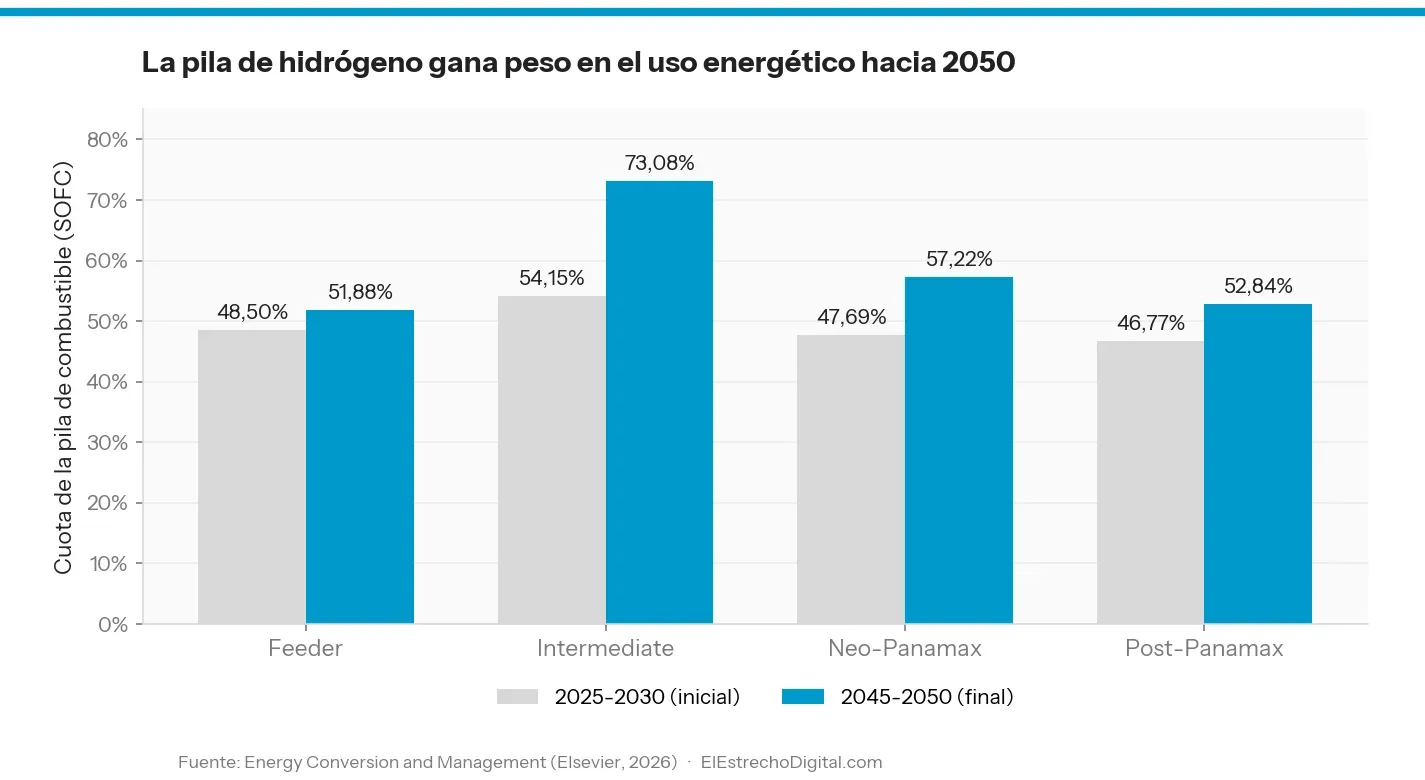
Energy usage patterns evolve throughout the transition. In the initial phase, the internal combustion engine provides slightly more energy than the fuel cell in the Feeder, Neo-Panamax, and Post-Panamax ships (between 51.50% and 53.23%), while the Intermediate ship relies more on the fuel cell (54.15%). Towards 2045-2050, the energy use of the solid oxide fuel cell exceeds that of the engine across all ship types, in a range from 51.88% in the Feeder to 73.08% in the Intermediate.
Regarding fuel choices, in the initial period all ships resort to bio-methanol for the engine, while fuel selection for the fuel cell varies: Feeder and Intermediate ships use blue hydrogen, and Neo-Panamax and Post-Panamax ships directly use electrolytic hydrogen (e-hydrogen) with zero emissions to reduce the greenhouse gas intensity of the fuel. The fuel composition of the engine changes more notably between 2030 and 2035, particularly in the Intermediate ship, where grey, blue, and biogas methanol coexist. Despite its higher cost, e-hydrogen remains the final fuel that enables deep decarbonization and plays a decisive role in long-term transition trajectories.
The cost analysis shows that total expenditure increases with the size of the ship and is dominated by fuel consumption, whose share fluctuates between 51.52% and 64.68% in the first stage and between 60.95% and 67.15% in the second. The penalty costs associated with the fuel standard (GFS) proposed by the IMO —set at $100 per ton for the first tranche and $380 for the second— are found to be insignificant, pointing to a preference for fuels with lower life cycle emissions even if they are more expensive. The early installation of wind propulsion and solar panels can be explained by their ability to replace part of the fuel consumption with a relatively low investment.
The study also examines how various penalty mechanisms affect initial decisions. In a scenario without penalties, all ships resort to grey methanol with blue hydrogen; with the introduction of the GFS mechanism, Feeder and Intermediate ships tend towards biogas methanol with blue hydrogen, while Neo-Panamax and Post-Panamax ships move towards biogas methanol with e-hydrogen. Higher penalty rates tend to increase the capacity of the fuel cell, especially in larger ships. A parallel analysis of the infrastructure cost overruns related to the storage, handling, and refueling of fuels indicates that these reduce the fuel cell's usage share and raise that of the engine, without altering the dominant hybrid architecture.
The research warns that its results should be interpreted as optimized transition trajectories under the assumptions of the model and not as precise predictions for specific fleets. It also notes that the technologies for converting hydrogen into propulsion power are still maturing and have not reached widespread commercial deployment, and that the supply chains and refueling infrastructure for e-hydrogen remain underdeveloped. A sensitivity analysis included in the supplementary material suggests that, at the low end of hydrogen prices, early configuration decisions could shift towards a combination of marine gas oil (MGO) engine and hydrogen fuel cell, maintaining the MGO engine as a flexible transitional option. The methanol and hydrogen architecture remains stable across the different scenarios analyzed, while cost factors continue to influence capacity allocation, energy usage shares, and specific fuel choice.